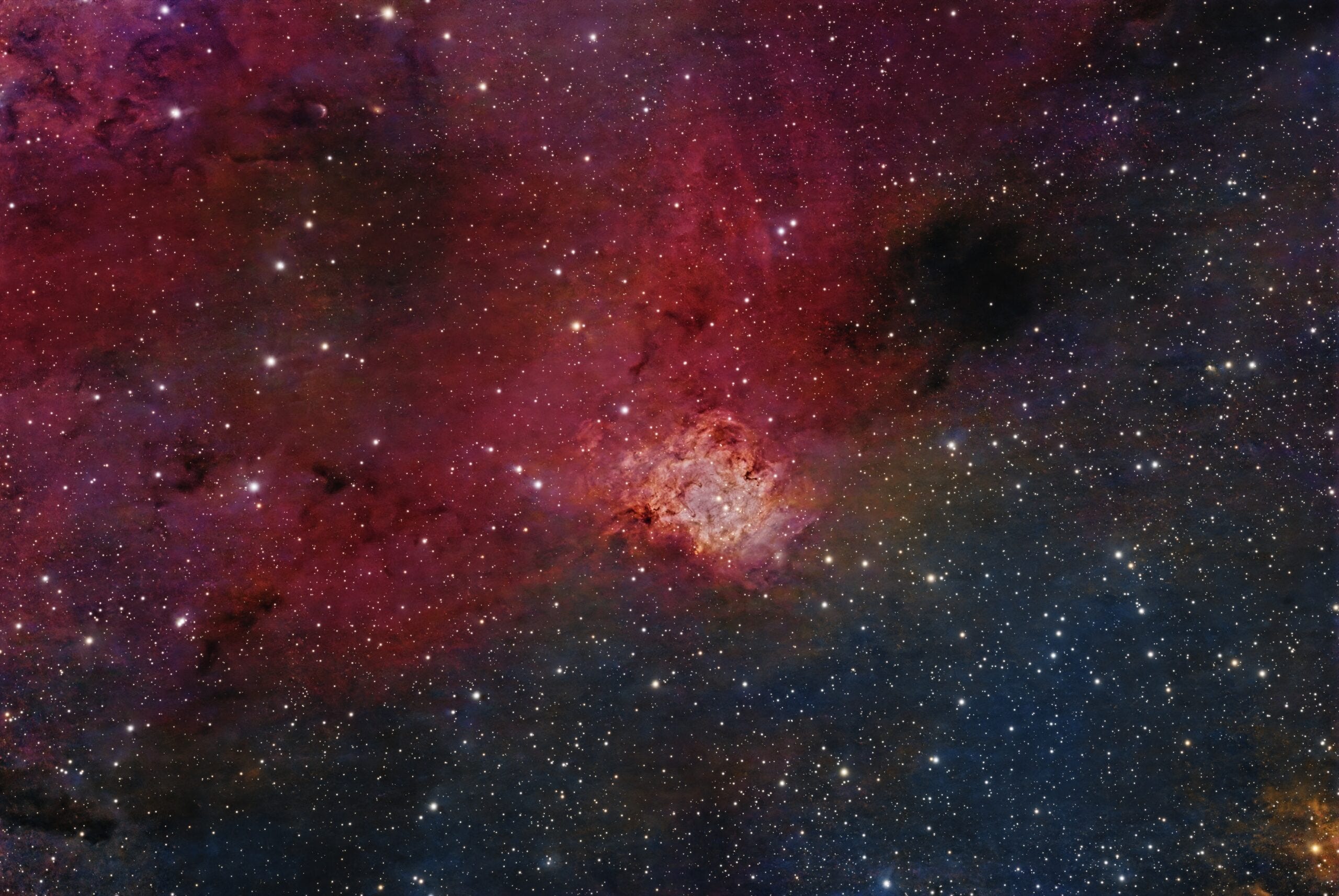
A trillion stars in the sky, a forest in Maine and a legacy to preserve
Bryan Wells' demonstration forest in Milford is an ongoing project

As an engineer, Old Town resident Bryan Wells tends to look at things through a practical, process-oriented lens. That’s why astrophotography appealed to him as a hobby - it takes many days of planning to capture a good image of a galaxy or nebula, from careful tracking of the weather to ensure a cloud-free sky, to the exacting precision with which the telescope and camera must be positioned in order to track the object being photographed.
Once that delicate process is over, however, Wells can’t help but sit back and reflect on the meaning of it all. Sitting in his observatory on the 1,058-acre demonstration woodlot straddling the town line between Milford and Greenfield that he and his late wife, Pam, maintained for more than 20 years, it’s hard not to look around at the land, the trees, the wildlife and the sky and think about what it all means.
“She’s always kind of in the background when I’m out here,” Wells said of Pam, who died in June 2025 after a years-long battle with primary progressive aphasia. “It’s nice, and it’s also sad. I have to grieve, but I also have to live. The land is so connected to her. Sharing it with people is part of the process.”
Wells’ brilliantly colored and highly detailed images of deep space objects will be on display on March 28 at the 2026 Maine Science Festival, at the Cross Insurance Center in Bangor, in an exhibit sponsored by the Forest Society of Maine. Wells will also give a presentation on the astrophotography process at 1:30 p.m. that day.
Bryan and Pam bought what they would come to call Wells Demonstration Forest in 2004. At the time, the land had been clear-cut, with all the valuable timber taken by logging companies with little regard for best ecological practices. Pam Wells, a Bangor native, had spent her life dreaming of being a forester, but sexism in the forestry field discouraged her from studying it when she was at the University of Maine in the late 1970s. When she and Bryan bought the woodlot in 2004, it was a chance to return to that dream - and build a model for forest restoration that students and the community could learn from.
The Wells’ spent the better part of 20 years painstakingly restoring the forest alongside a team of local forestry professionals and volunteers, and building trails so the public could visit. Pam Wells also worked specifically with women, teaching them how to operate chainsaws and learn the basics of forestry - many of whom went on to become foresters themselves. For their efforts, the couple were named the Maine Forest Service’s Tree Farmers of the Year for 2017.
Today, Wells Demonstration Forest has a thriving ecosystem, with an array of mammals and birds now making the land their home, and the Sunkhaze Stream - the Wells’ forest abuts Sunkhaze Meadows National Wildlife Refuge - running clean and clear through it.
Bryan Wells intends to carry on his wife’s legacy as a forester by maintaining the partnerships the couple had already established. A conservation easement on their forest is in the process of being purchased by the Forest Society of Maine, a Bangor-based nonprofit which manages hundreds of thousands of acres of forest land across Maine, permanently protecting it from development.
“The goal is always to keep forests intact and from being fragmented, to protect them from development and to prevent sprawl,” he said. “It also has the added bonus of protecting the dark skies we have in Maine, which helps everyone - including wildlife. And, well, it’s great for astrophotography too, though that’s just a nice bonus for me personally.”
Pam and Bryan shared many passions, one of which was photography. Almost as soon as they bought the forest they began photographing the flora and fauna there, all documented on their photography website, Oakleafs Studio. In 2014, Bryan Wells took it a step further and purchased a telescope and camera setup, with the intention of capturing the night sky.


Now, more than a decade into learning how to photograph deep space, Wells’ astrophotography hobby has grown from a telescope and camera in his backyard to a full-on solar-powered observatory at the woodlot, with its own building and permanent setup utilizing the latest technology. Wells is in the process of building a camp next door to the observatory, so he can spend the night out there in the warmer months.
“It’s a process that requires a lot of patience. It’s a very long exposure. You have to wait for a cloudless night, and you want to do it on a new moon so there’s no moonlight. That means there’s usually only five to six opportunities a year to get something really great,” Wells said. “Everything has to go right in order to make it happen.”
In the past year Wells has spent a lot of time reflecting and reconnecting with his spirituality. He is in the beginning stages of exploring how to build a low-impact campsite on the woodlot, where he could host summertime retreats for people interested in nature, spirituality and photography. Sharing their land - and Pam’s legacy - is important to him, whether it’s through forestry practices, capturing images of wildlife and the night sky, or simply experiencing nature.
“When you hear a coyote howl or an owl call, it does have a spiritual element to it,” Wells said. “I think the awe I feel is less about the vastness of the universe, and more about how lucky I am that I am sitting on my land, using a telescope that didn’t exist 10 years ago. I think about all the things that had to happen in order for me to be here, doing what I’m doing. I think about the life Pam and I built. So, it’s not so much how insignificant I am with all the trillions of stars. It’s more about how lucky I am to be here.”


