

A walking tour of the Urban Renewal district of downtown Bangor
As presented during Maine's Jane's Walk weekend, May 2

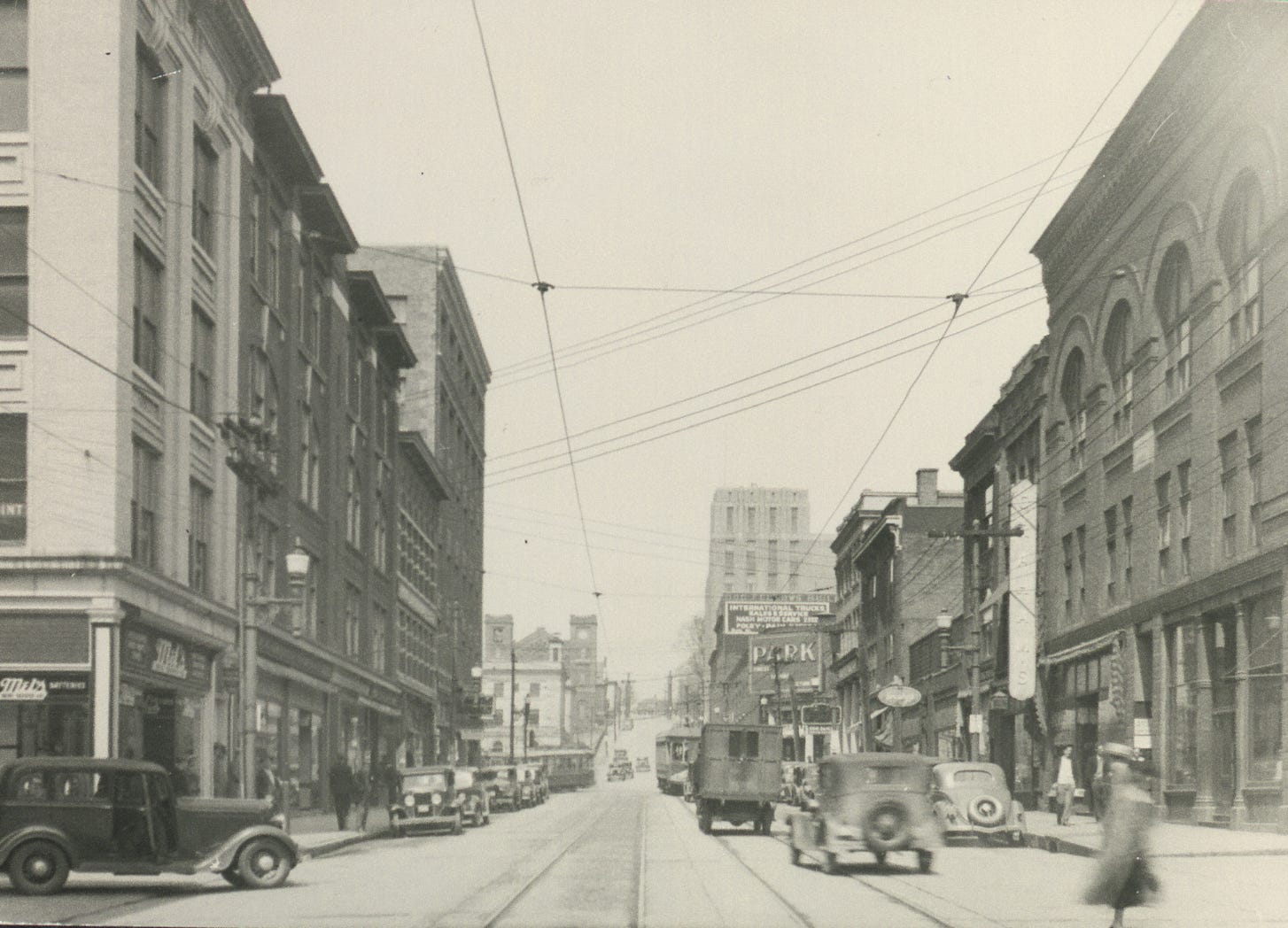
Last weekend I had the pleasure of leading a Jane’s Walk in downtown Bangor, as part of the statewide Jane’s Walk programming organized by Maine Preservation. My topic, unsurprisingly, was on Urban Renewal and its impact in Bangor - one of the major focuses of my book, “Downtown, Up River: Bangor in the 1970s,” and an era in the city that still impacts how we view our community more than 60 years after the project was approved.
Before we go any further: What are Jane’s Walks? Glad you asked: Jane’s Walks are an annual festival of free, community-led walking conversations inspired by Jane Jacobs, the urbanist and thinker whose 1961 book, “The Death and Life of Great American Cities,” helped people reimagine how cities function and thrive. Jacobs died in 2006, and shortly afterwards Jane’s Walks were started as a way to honor her legacy, with the goal of helping people learn new things about and imagine new ways of living in their towns and cities. Community storytelling and connecting history to people’s lived experience and present-day issues is 100 percent my bag, so I of course love this program!
Here are all the places we stopped and some of the highlights of our walk, which took us down Exchange Street, across the Kenduskeag Stream and through Pickering Square and beyond.
Stop one: The Nichols Block, built in 1892 and located at the corner of Exchange and York streets, is the only 19th century building that remains on Exchange Street today. The Great Bangor Fire of 1911 took most of the other buildings surrounding it, and then Urban Renewal took the rest all the way down Exchange Street. It most recently housed the Bangor Arts Exchange in the third-floor ballroom, which closed in late 2024. From the 1890s until the 1960s, that space was called Society Hall, and regularly hosted dances and small musical ensembles where Bangor “society” could see and be seen.
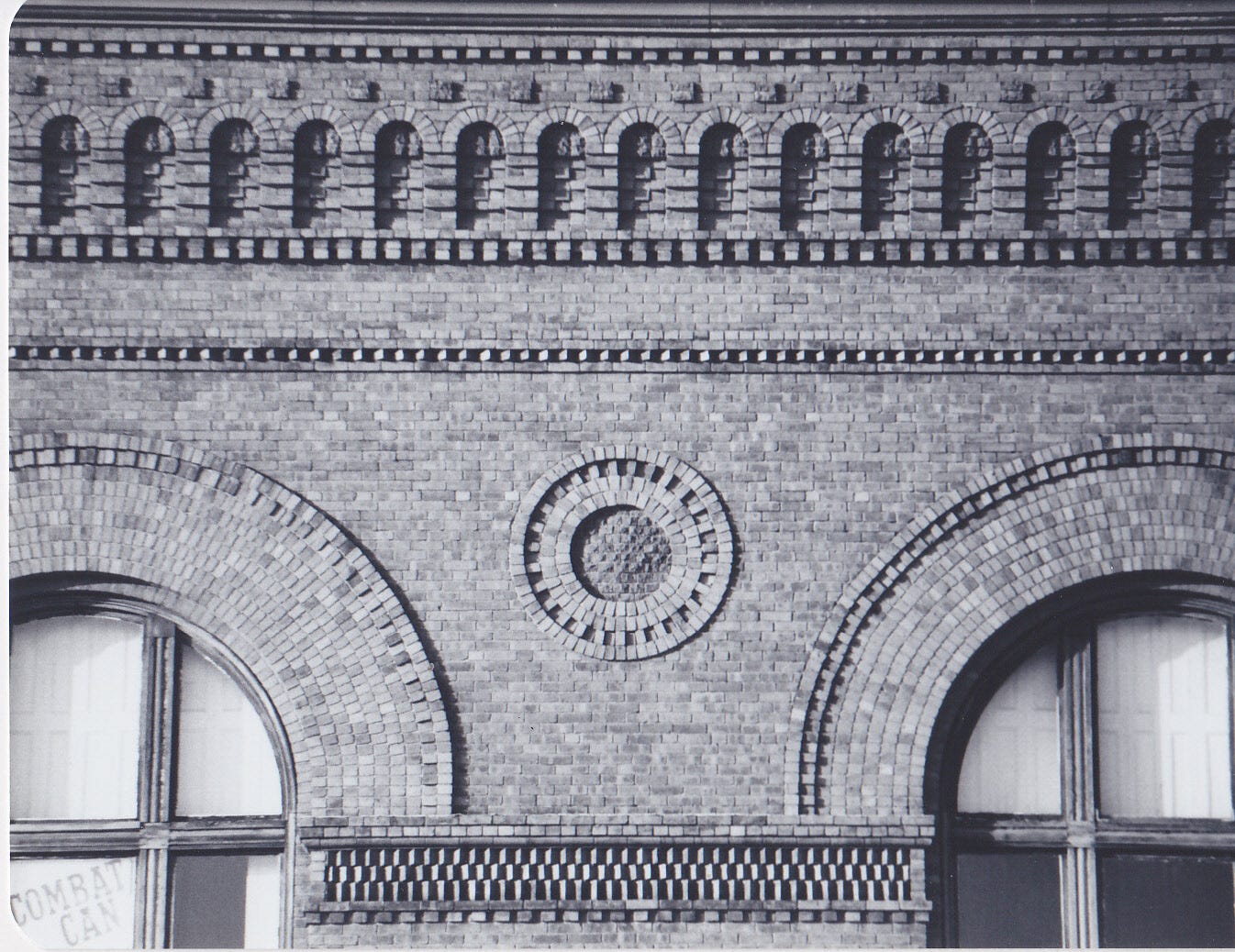
Not only is the Nichols Block an architecturally important building - it was built in a Romanesque style and sports attractive half-moon windows, and was designed by acclaimed Maine architect Wilfred Mansur - it’s also symbolic of the drastic changes wrought by both disasters and by city policy in the early to mid-20th century. As the last remaining pre-Fire building on the street, it’s our last link to the “old” Bangor, where densely-packed clusters of buildings and businesses made the economic center of the city thrum with activity, and which attracted a diverse array of people to the downtown.


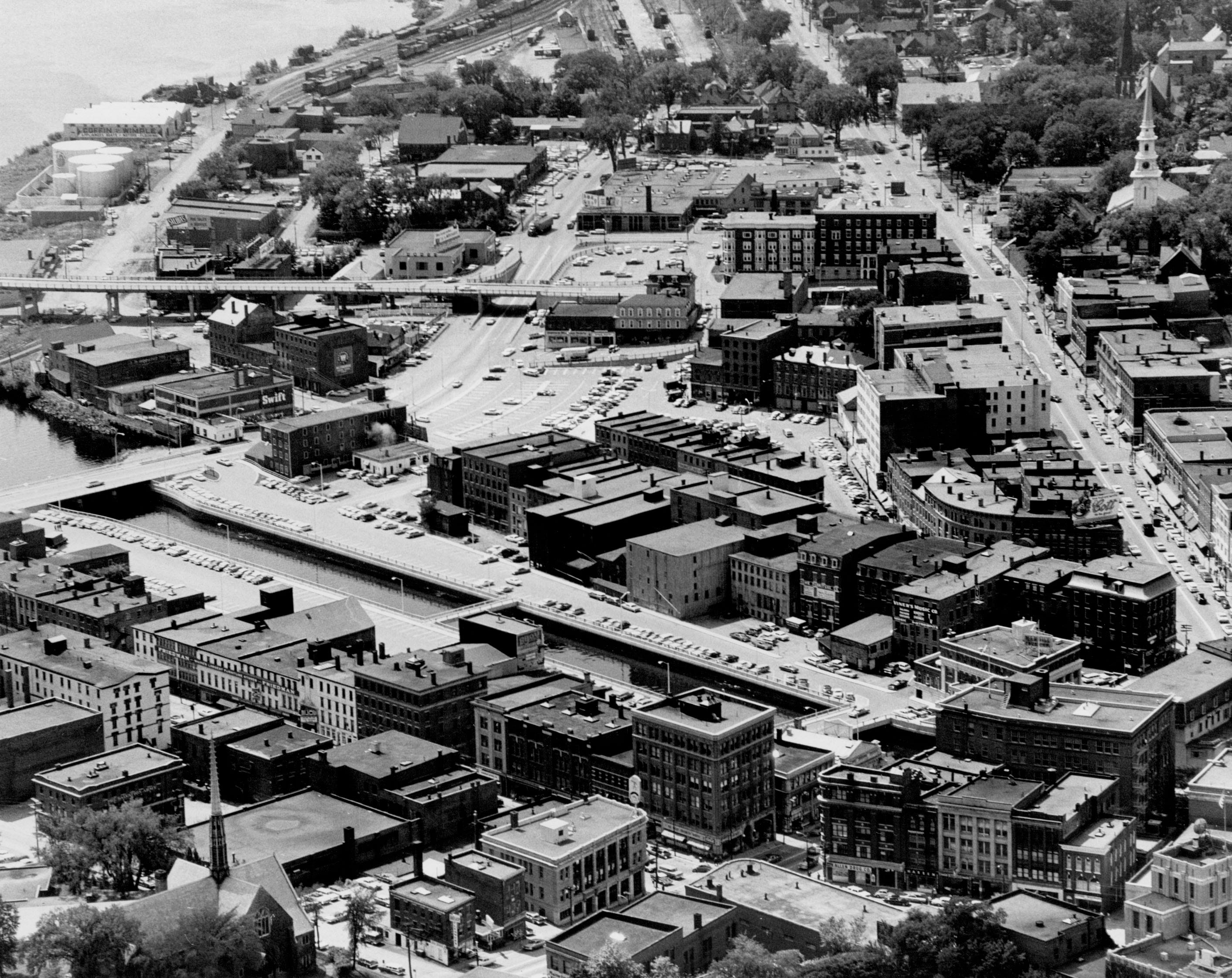
Stop two: Past the corner of York and Exchange we can see the full breadth of how the Urban Renewal era changed - not by what is there, but by what’s not there.
A little backstory: Urban Renewal was a federal program that offered cities across the U.S. large grants to tear down old, unsafe, substandard housing and build safe, modern housing. Bangor approved its Urban Renewal program in June 1964 by a slim margin, with the main goal at that time being to demolish “slum” housing in areas off Stillwater Avenue and along Hancock Street near the river. It wasn’t a bad idea, in theory - even in the 1960s, many of those houses lacked things like indoor plumbing, safe electrical wiring and any sort of heat aside from wood stoves. Along Hancock Street in particular, much of the housing stock resembled the tenement buildings you might see in images from the Great Depression. It was rough stuff, and building safe, modern housing is rarely a bad idea.
Not long after the city approved the program, however, the federal government changed the scope of what projects the Urban Renewal could fund - instead of mostly housing initiatives, cities could now use the money to do things like widen streets, tear down old commercial buildings and make way for modern economic development and infrastructure projects in downtown areas. In short: Bangor now had a funnel of federal money to undertake an ambitious redesign of much of its historic downtown.


When Urban Renewal really got going in 1968, Bangor enthusiastically began demolishing buildings all along Exchange and French streets and right up to the banks of the Kenduskeag Stream, with an eye to making the downtown much more accessible to cars, and removing buildings that the members of Bangor’s Urban Renewal Authority (URA) deemed “substandard” or “unsafe.” In reality, however, it cleared out more than a century’s worth of history and development to make way for cars: driving them and, most especially, parking them. Car culture in the U.S. was at its zenith in the 1960s and 70s, and Bangor’s URA considered accommodating those cars among its top priorities - a far cry from the housing-centric program sold to Bangor residents a few years prior.
Stop three: Many of the businesses and property owners affected by the destruction of the Urban Renewal era did not take it lying down. The way the program worked was that the city would offer those owners a federally-backed buyout for their property. If the owners refused, the city would then take the building by eminent domain - a kind of “we can do this the easy way, or the hard way” situation. Some owners were happy to take the money and run, but several - like the Waverly Hotel and Lounge and clothing wholesalers A. Emple & Co., both on French Street, and the iconic Bijou Theatre on Exchange Street - resisted the buyout, either through lawsuits or through waiting until they had no other choice. The Waverly, by the way, ended up moving to Merchant’s Plaza, where it’s still going strong 108 years after it opened!


In the end, though, none were able to fight City Hall. By 1974, the entirety of Exchange Street from York Street to the riverfront was demolished, while French Street from York to the river did not merely see its buildings destroyed - the street itself was eliminated. In downtown alone, the total devastation was equivalent to roughly six city blocks, or nearly 14 acres - and that’s just between York, Washington Street and Broadway.
Unless you were around for it - and, delightfully, many folks on our Jane’s Walk were! - it’s hard to picture the area as densely-packed and bustling. Merchants and restaurants and bars and warehouses, people busily buying and selling goods and services. Ethnic diversity, too: there were a number of Jewish, Chinese and Italian-American owned businesses in the area, in addition to the long-established Greek, Irish and Lebanese populations in Bangor. A side effect of urban renewal projects in cities all across the U.S. was the fact that immigrant families and people of color were often pushed out of the areas targeted for “renewal” - though it’s easy to see that such efforts were, in many cases, more of an intentional feature than an unintended consequence.
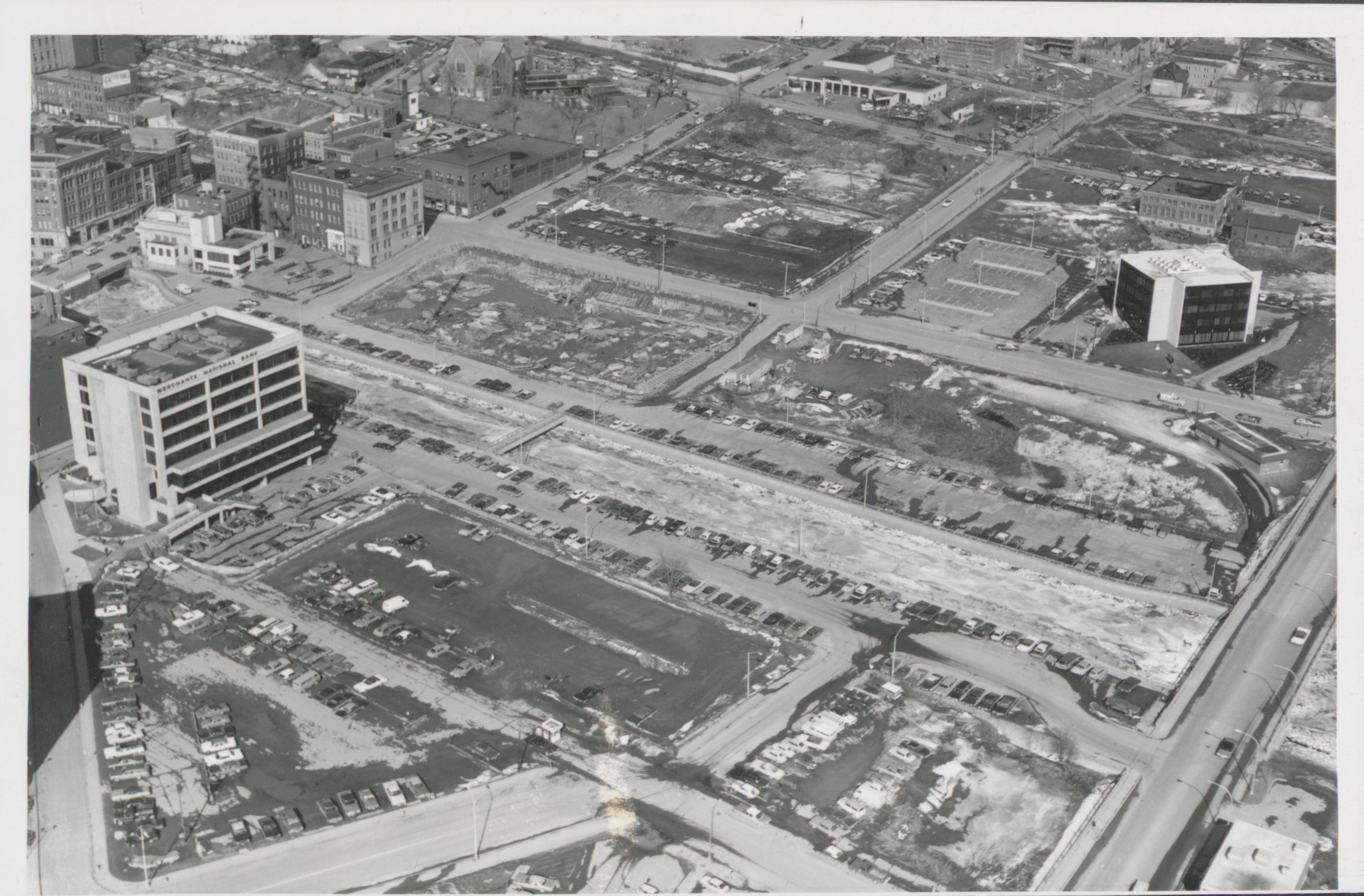
Stop four: In the zeal to tear down old buildings and rebuild with safe, modern buildings, Bangor’s URA seemingly forgot to line up the developers and projects that would undertake the rebuilding in that 14-acre footprint. Slowly, projects like the buildings that now house Camden National Bank and Rasa, the new Indian restaurant, began to materialize in the 1980s, with the last major project in the Urban Renewal area being the “new” Penobscot County judicial building in 2009 - 40 years after the first wrecking balls began to swing.
Across the stream, in Pickering Square and the areas immediately adjacent to it, the same thing happened - lots of leveling, little rebuilding. In fact, that part of downtown remained mostly empty until the early 1990s, when the parking garage was built - which itself replaced a huge, open parking area that subsumed all the land from Merchants Plaza down to the stream. Parking has long been a bugaboo and all-consuming problem for downtown Bangor - a direct result of American car culture and our obsession with convenience, despite its impracticality and wasteful use of precious resources. Imagine if, instead of focusing so much on parking, we could focus instead on things like attracting new businesses, encouraging walking and biking, and building a downtown that works for everyone - not just for cars? But I digress.


Slowly but surely, however, new developments have begun to reconnect the rest of downtown to the disjointed and poorly planned Urban Renewal area, beginning with the remodeling of West Market Square in 2014 and, most recently, with the nearly-finished redesign of Pickering Square and construction of the transit center. In 2021, an attractive new footbridge replaced the crumbling old one over the stream. And, as anyone that’s lived in Bangor for more than 20 years will tell you: the downtown is a much, much livelier, busier and more fun place to be than it was in its nadir in the 1980s and 90s.
That bridge, to me, represents the best of the ways in which we recommit ourselves to fixing the mistakes of the past and looking toward the future. So does the redesign of Pickering Square, to serve the dual purpose of encouraging the use of public transportation and being an accessible, useful public space in the center of downtown. 100 years ago, Pickering Square was bustling with merchants and carts and vendors and life. Finally, we have the chance to bring back some of that vibrancy - not because we tore things down, but because we built them up.
Urban Renewal has a deeply complicated legacy. Though the general consensus seems to be that it was more bad than good, as we always end up learning: things are never that simple. There undoubtedly were hazardous old buildings just waiting to catch on fire - or collapse into the stream - that likely did need to be renovated and shored up, if not torn down. There were plenty of infrastructure issues that were addressed by it. And the idea of rethinking how things work in order to adapt to new technologies and ways of living isn’t, on paper, a bad thing.
Still, it’s hard to look at the destruction wrought and say it was a success - it certainly wasn’t. Much was lost, both economically and culturally. The question, then, is: what do we do with what’s left? Clearly, nearly five decades later, we still have not answered that question. I would argue, however, that we’re a whole lot closer to figuring it out now.
Seeing the ongoing strength of Portland's Old Port and, on a smaller scale, downtown areas like Belfast and Rockland, it is discouraging to see how Bangor shot itself in the foot with this redevelopment (which also included building the Bangor Mall and rerouting business away from downtown).
Thank you for conducting the walk and writing it up for us. My grandmother used to tell me about Exchange Street as it was before and I remember seeing Pinocchio at the Bijou.
Much was lost, but we can rebuild our vision for what is possible: rebuilding all our cities for people first, not cars.