Bangor's LGBTQ+ community has always been here. There's no hiding anymore.
Images from decades of struggle, joy and transformation in the Queen City

To the rest of the country and much of the rest of the state - and despite intentional and crucial work to reverse the association - Bangor’s LGBTQ+ history is intertwined with violence. The 1984 murder of Charlie Howard, a young man attacked and left to drown by three local teenagers explicitly because he was gay, horrified gay and straight people alike. Howard’s brutal death remains a defining moment for the LGBTQ+ community in Maine, and Bangor will forever be associated with it.
But the gay rights movement in the state - and specifically in the Bangor area - that Howard’s death galvanized started more than a decade prior, in the wake of the 1969 Stonewall riots and a subsequent national awakening about rights for gay and trans people. And, of course, gay, queer and trans people have always existed, even in small towns and cities like Bangor. The record shows it. The stories of the people who experienced it are known, and retold. The lives lived today strengthen and vitalize our communities.
It’s easy to look at the size and scope of Pride celebrations statewide and think about all the progress that has been made, especially in comparison to just a few decades prior, when something as simple as a parade would be considered a shocking public display. It’s clear, however, that that progress is hard-fought and hard-won, and can just as easily be stripped away by a few court cases or executive orders. Last week someone twice defaced the Pride crosswalk next to Charlie Howard’s memorial by the State Street bridge in downtown Bangor. The vile, careless comments about it left on social media only further prove the point that the fight is far from over.
Over the past few years I’ve squirreled away multiple images of those early years of LGBTQ+ life in the Bangor area, and of the fight to secure rights for gay and trans people in the state, gathered from longstanding collections like those at the University of Maine and the University of Southern Maine, and from the Bangor Public Library and the Bangor Daily News. Many of these images may be familiar to some; many more likely haven’t been seen in decades.
One of the first gay rights organizations in the state was founded in Bangor in late 1972. Gay Support and Action was a small but mighty group that was the direct precursor to a more well-known organization: the Wilde Stein club at the University of Maine, founded in April 1973, and which met weekly in the Memorial Union.
Later in 1973, Wilde Stein announced plans to host the Maine Gay Conference, the first gathering of its kind in Maine - a plan opposed by UMaine administration, who feared public backlash. According to a 2023 article in Maine Alumni Magazine, the administration might have gotten its wish were it not for a January 1974 federal court ruling that found that the University of New Hampshire had unlawfully denied UNH’s Gay Students Organization (GSO) the right to hold functions on campus. After heated debate among administrators, the conference was allowed to go forth in April 1974. Predictably, groups like the Christian Civic League and Maine fundamentalist churches were outraged, and lodged their homophobic complaints in the Bangor Daily News and other media outlets. Some conservative Maine legislators even threatened to try to pull state funding from the University, though those threats never materialized.


In the end, the three-day conference attracted more than 300 people - double what was expected - and despite a few homophobic incidents on campus, organizers Karen Bye, Steve Bull, John Frank, Dan Estes, John Noble and David Cadigan were vindicated. Today, Wilde Stein continues to thrive, 53 years after its founding. I remember going to my first Wilde Stein meeting during my freshman year of college at UMaine. I have friends I met there that I still consider among my very closest. In many ways, it changed my life.
While campus activism in Orono remained prominent throughout the 1970s and attracted LGBTQ+ people from all over the state, in Bangor, queer life was much less visible - though certainly not non-existent. “A Gay Person’s Guide to New England,” published in 1975, devotes six whole pages to the entirety of Maine, New Hampshire and Vermont, where Bangor is reasonably well represented. Among the spots the magazine’s contributors point out in Bangor are bars and lounges including Peter’s Candlelighter (a.k.a. The Main Tavern, which it says is “distinctly cruisy” after “the witching hour”), the lounge at the Bangor House Hotel (“gay since forever”) and Benjamin’s, which it says is getting “gayer by the minute.” By the 1990s, Benjamin’s, on Franklin Street, was home to The Bar, a longtime Bangor gay bar, and later Karma and Fusion, both popular 2000s queer nightclubs (I was there!). Bangor doesn’t have a gay bar anymore. I think that’s sad.
The magazine also mysteriously refers to “The Pub,” an unnamed establishment somewhere in Bangor that it suspects is just another way to refer to Benjamin’s or Peter’s. Regardless, in the research for my book, “Downtown, Up River: Bangor in the 1970s” I came across these incredible photos in the BDN photo archive of a drag queen performing somewhere in Bangor in 1975. As far as I can tell, these images were never actually published in print, but they miraculously survived and are some of the vanishingly few public documents of queer social life in Bangor - not to mention of gender non-conforming or trans folk. It would take another 22 years for the BDN to take photos of drag performers, for a landmark 1997 article by my pal Judy Harrison about local drag queens. Then again, “female impersonators” were popular mainstream entertainment in the vaudeville era, judging by the regular advertisements for their performances at Bangor venues like the Bijou Theatre in the 1920s.


By the 1980s, things in the Bangor area weren’t looking dramatically different - LGBTQ+ visibility and acceptance moved at a glacial pace. The scourge of the HIV/AIDS epidemic was beginning its deadly creep into Maine. And 1984, as we know, saw the murder of Charlie Howard - both a tragedy and a turning point. People return each year on the anniversary of his death to throw flowers into the Kenduskeag Stream, from the bridge where he was attacked.


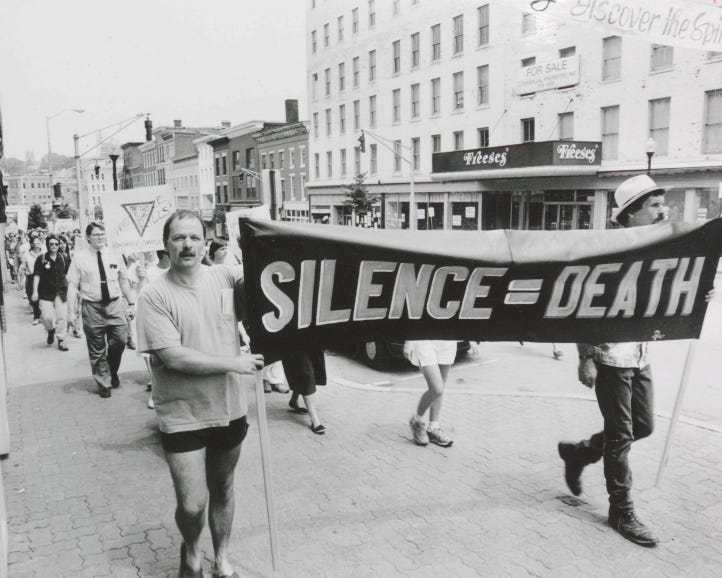
From that point on, however, that slow pace began to quicken. Just a few months after Howard’s death in July 1984, the Maine Lesbian Gay Political Alliance formed, the precursor to EqualityMaine. Gay rights bills were put in front of the Maine Legislature with every new election, though it would take until 2005 for discrimination based on sexual orientation or gender identity to be outlawed statewide, and until 2012 for same sex marriage to be legalized. HIV/AIDS activist organizations like ACT UP founded chapters in Maine and began to make noise and offer information and support statewide - including a notable 1992 effort to distribute condoms and safe sex information at high schools throughout Maine, including at Bangor High School.


Pride parades and festivals also began to take shape in Maine, first in Portland, in 1987, and in Bangor in 1992. The below photos were all taken from the 1994 parade in Bangor. Except for 2020 and 2021, when another global health catastrophe rocked the world, it’s happened every year since. Bangor’s parade and festival this year is set for 11 a.m., Saturday, June 27, and as in more recent years, it’s expected to attract thousands of people - a dramatic increase from the 200 or so that came to the first year in 1992.


Sadly, it’s occurring this year amid a spike in HIV/AIDS cases in eastern Maine, and renewed threats and violent rhetoric to the LGBTQ+ community and the people who love them. The more things change, as they say. So much progress has been made. So much work is left to be done.
Do you have your own stories or photos to share? Did I miss something? Leave them in the comments below, or respond to this post in your email.


