


I’ve spent countless hours with books, podcasts and documentaries about every type of cult that’s out there. Heaven’s Gate, Branch Davidians, NXIVM, the People’s Temple, Scientology, Aum Shinrikyo, you name it - I’m a bit obsessed. How does a person become the kind of sociopath that starts something like that? And how do otherwise regular people get sucked in, and often end up doing horrible things to themselves and others? I never tire of those questions.
Naturally, I have a particular interest in the cults that have formed or operated right here in Maine. There are a surprisingly large number of them - practical, skeptical Mainers might seem more immune to the charms of such charlatans, but that just shows how easily some people can be manipulated into joining groups that seem so detached from reality.
There’s the Holy Ghost and Us, a turn-of-the-19th-century Christian sect based in the town of Durham, founded by a Maine preacher who ended up taking his followers on a doomed ocean voyage around the world. There’s the Millerites, who in 1844 famously awaited the Rapture at locations throughout Maine only to experience what is now known as the “Great Disappointment.” More recently, the now-defunct Gentle Wind Project in Kittery was embroiled in lawsuits in the early 2000s alleging its leaders engaged in financial and sexual exploitation and cult-like behavior, and in 2024 two Maine brothers published a book detailing the cult-like practices of the former Faith Baptist Church in North Yarmouth.
Perhaps the most outrageous of them all, however, was the Church of the Messiah. 160 years ago this summer, 156 residents of Washington County loaded thousands of pounds of Maine lumber aboard a ship in Jonesport and set sail for the Palestinian city of Jaffa, today a part of the Israeli city of Tel Aviv. Once there, they planned to construct homes for the Jewish people they hoped to re-migrate back to Israel in order to - you guessed it - bring about the Second Coming of Jesus.
There’s a long tradition in the U.S. of Christian zealots obsessed with Israel, and with jumpstarting the End Times and the Second Coming by returning the Jewish people to the Holy Land. There are plenty of them around today, given the support many of those Christians have for the Israeli government - despite the fact that it is doing something profoundly sacrilegious by committing genocide against the Palestinian people. Longing for the world to end has always felt deeply selfish to me, as it usually implies that only a handful of “chosen” people get to live on past it, while the rest of us suffer or die. But I digress.
The man that managed to convince 156 Down East farmers and fishermen and their families to give him all their money and set sail for Jaffa was George Jones Adams, a New Jersey native, an itinerant preacher, and a failed Shakespearean actor. After his career in theater failed, in the 1840s, Adams converted to Mormonism, rising in the ranks of the church until he grew close to founder Joseph Smith. In 1846, however, after Smith’s assassination, Adams was kicked out for claiming he was the most powerful of the church’s apostolic leadership, and pushing for Smith’s son to be the new church leader, instead of Brigham Young. Adams then went on to join an offshoot of the Church of Latter-Day Saints led by fellow excommunicant James Strang, only to be kicked out of Strang’s church in 1851 for drunkenness and adultery.
By the mid-1850s, Adams had moved to Maine, and began preaching up and down the coast, according to a 2016 article in Down East Magazine. Adams attracted new followers in villages throughout the state with his frenzied sermons and theatrical antics, blending a potpourri of Christian traditions from Baptist to Mormon. Adams started a newspaper, “The Sword of Truth and the Harbinger of Peace”, with Jonesport resident Abraham McKenzie, and eventually founded his own church, the Church of the Messiah, also in Jonesport. Hard to get kicked out of the church again when you’re the one that founded it.
How did Adams manage to attract so many followers, particularly in Down East Maine? The “Great Awakenings” of the late 18th and early 19th centuries were seizing many Americans with evangelical religious fervor, especially in more rural areas. Many of the itinerant preachers like Adams who roamed the countryside wrapped up their sermonizing in postmillennial promises of the Second Coming - compared to the reality of their difficult lives, the end of the world may have seemed like a nice alternative to poverty-stricken farmers.
Add to that the great trauma of the Civil War, when nearly 10 percent of Mainers representing around 80,000 men went away to war, nearly 13 percent of whom died in battle or from disease. A significant percentage of those soldiers and sailors that returned quickly left Maine to make their fortunes out west, a significant blow for rural economies. Economically and spiritually, some Mainers were easy targets for a swindler like Adams.
In 1864, Adams - who at that point claimed he was a prophet of Jesus Christ - announced to his flock that he was ready to embark on a great mission. He would build a colony in Jaffa, constructing houses out of Maine lumber for the Jewish people who they would then repatriate back to the Holy Land. One the Jews returned, Jesus would shortly follow, and the world would be made anew.
In order to undertake this mission, Adams needed money, and lots of it, mostly to purchase a huge number of Whitneyville-built prefabricated houses - a precursor to the modular homes we know today. He also needed people to agree to abandon everything they’d ever known in Maine and set sail for a foreign country. Such was his skill as a manipulator - a crucial skill for a cult leader - that he got more than 150 people to sign away their money and their lives to him, mostly from tiny Washington County towns including Jonesport and Addison.
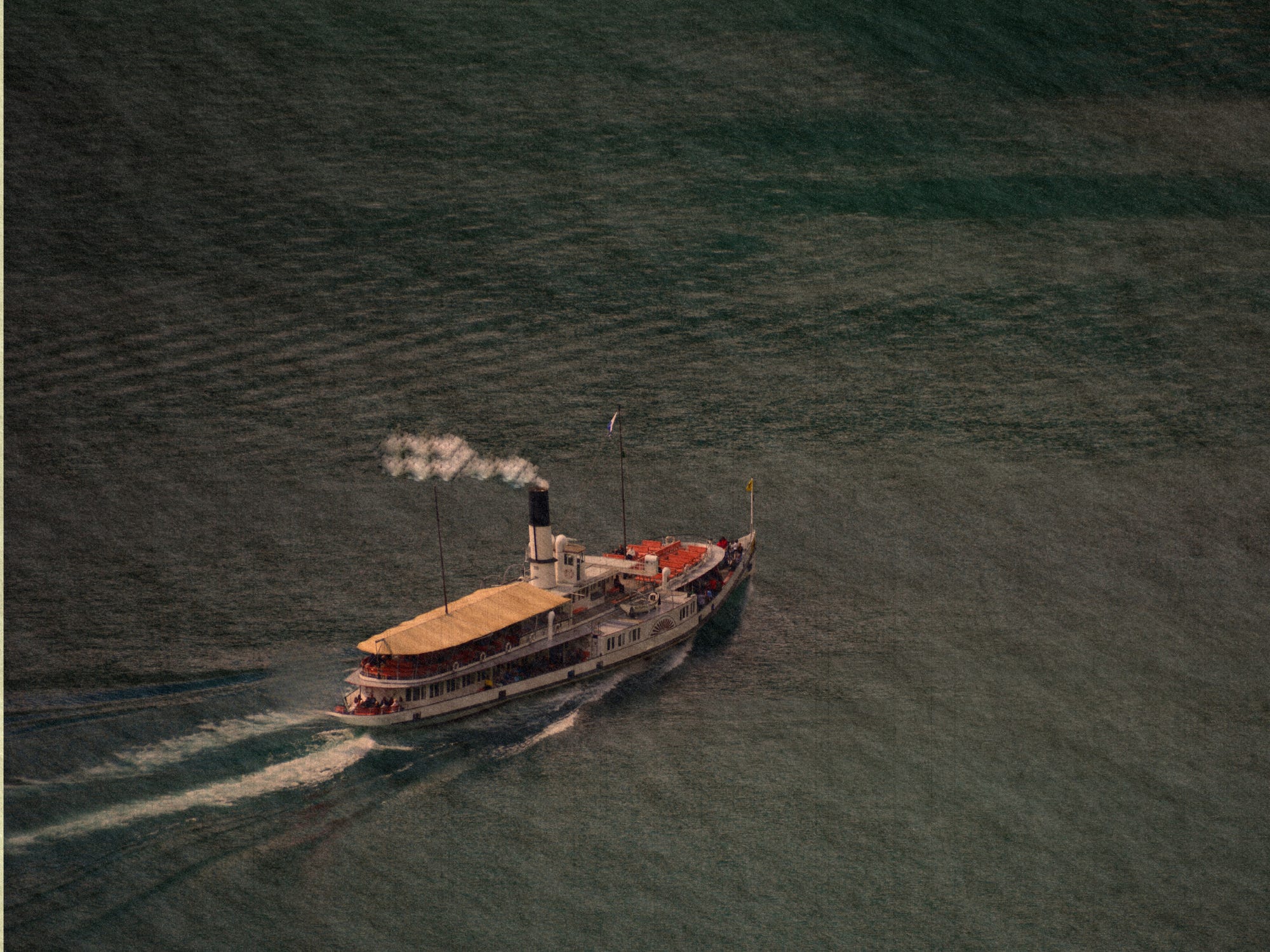
Adams and McKenzie in 1865 traveled to Jaffa on their own before the mission set off, arranging a deal to purchase a tract of land in Palestine. Adams then asked President Andrew Johnson and Secretary of State William Seward to petition the Ottoman Empire to formalize the purchase. That deal wasn’t finalized yet, however, when Adams and his colonists loaded up a ship named the Nellie Chapin and departed from Jonesport on Aug. 11, 1866. That was only the beginning of the troubles the Jaffa colonists would face.
The ship arrived in Palestine on Sept. 22, 1866, and Adams quickly learned that the land deal he’d spent months arranging had been rejected by the Ottomans. Faced with few options, the colonists camped out on the beach for six weeks, constructing tents out of whatever fabric and lumber they could spare. Within a few weeks, they had already started to run out of food, and the drinking water began to go bad. Cholera began to spread through the camp, and by mid-November of that year, ten colonists had already died.
Over the winter, Adams finally was able to acquire his land (by pretending to be a Turkish citizen) and the colonists actually did start to build houses and plant crops - though conditions had by no means improved, with still more colonists dying from disease and starvation due to crop failure in the hot Palestinian sun. Some began to notice that Adams was doing a terrible job at hiding his drinking, noting that several dozen empty bottles of liquor were among his possessions. By the spring of 1867, the Jaffa colonists had fractured, with more than half of them abandoning the mission and booking passage back to the U.S., penniless and filled with regret. In total, 17 colonists died.
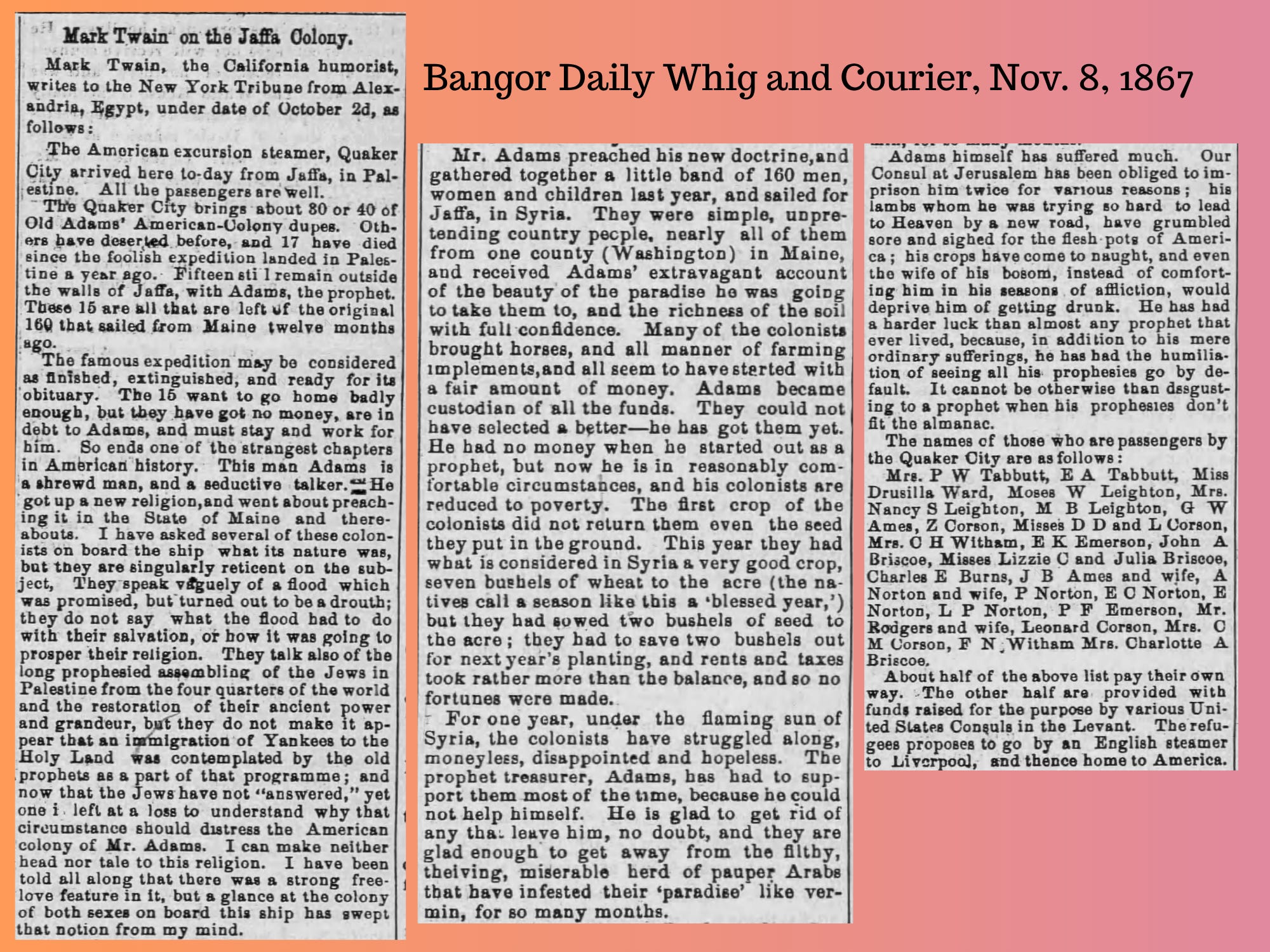
The last group of Maine colonists to leave Jaffa were around 44 individuals, who then Maine Gov. Joshua Chamberlain arranged passage for on a steamship called the Quaker City that departed for Boston in October 1867. On that same ship was none other than Samuel Clemens, a.k.a. Mark Twain, who had spent most of that year traveling through Europe, Russia and the Holy Land on a writing assignment from both a newspaper and a publishing house. Twain was on his way back to the U.S. when he encountered the bedraggled colonists, who he memorably describes in his book, “The Innocents Abroad.”
“The colony failed on account of heavy taxes and poor crops… Adams, the Prophet, got drunk in September, 1866, and remains so to this day. It is to be hoped that he will see the error of his ways when he gets sober… I have asked several of those colonists on board the ship what its nature was, but they are singularly reticent on the subject…They talk of the long-prophesied assembling of the Jews in Palestine from the four quarters of the world, and the restoration of their ancient power and grandeur, but they do not make it appear that an immigration of Yankees to the Holy Land was contemplated by the old Prophets as a part of that programme… I can make neither head nor tail of this religion.”
Adams himself stayed in Jaffa for another year or so before finally decamping to England in 1868, eventually settling in Philadelphia in 1870. He restarted his Church of the Messiah there, though according to a 2024 article in New Lines Magazine, when asked about his connection to the Jaffa colony, Adams pretended to not know what they were talking about.
Despite the disappearance of their self-proclaimed prophet, a handful of those original Mainers stuck around in Palestine, which 80 years later became the state of Israel, and by the 1990s, a few of the colonist-built houses were still standing. In 2001, two Massachusetts residents, Reed and Jean Holmes, bought one of those buildings and undertook an extensive restoration, eventually dubbing it the Maine Friendship House; it still stands today, now located in a well-heeled Tel Aviv neighborhood.
The Jaffa Expedition would likely only be a footnote in history had Mark Twain not been aboard one of the ships returning weary colonists home; instead, their misadventures and miseries in the Holy Land are immortalized forever. As with so many people indoctrinated into fringe religious sects and other cults, the blame doesn’t really lie with the members, who only wanted a new life in a new place and to build a better world.
Instead, the blame lies with the swindlers, charlatans and zealots that use their charisma - alongside threats and careful manipulation - to coerce vulnerable people into doing things that are harmful to themselves and others. Whether it was financially struggling, isolated farmers in rural Maine in the 1860s, or financially struggling, isolated people on the internet in the 2020s, it only takes one charming, smooth-tongued snake oil salesman to get someone to give them everything - in return for nothing.
And now we have the cult of donny
Of course it was the Mormons! Swindled me, too. 😅❤️🩹 I love your writing!