


When it comes to folk legends and ghost stories in eastern Maine, the tale of Bucksport founder Jonathan Buck and his witch’s curse tends to get a majority of the attention.
It’s got everything: witchcraft, a public execution, a curse and a whole lot of colonial-era intrigue. Buck’s gravestone in Bucksport bears a vaguely foot-shaped discoloration, which people believe is a physical representation of the curse laid by the witch Buck supposedly sentenced to death sometime in the 1780s. Something about her chasing him in the afterlife, or that he’d never find peace, or something like that. Spooky, right?
Unfortunately, the details of the story just don’t line up. The time in which Buck lived - Revolutionary War-era New England - was long past the time of the famous witch trials in and around Salem, Massachusetts. Even if a witch could punish someone in the afterlife, Buck was born far too late to be involved in such a thing. The Buck’s grave legend, sad to say, simply isn’t true.
It’s a shame that’s the story that’s remained popular over the years, considering Bucksport has another gruesome tale that is far more interesting, and also happens to be 100 percent true: the story of Sarah Ware, and how, 128 years ago, her head got separated from her body.
Ware’s grave is far less impressive than Buck’s imposing granite monument, and it’s tucked back in quiet Oak Hill Cemetery in Bucksport instead of prominently displayed along Route 1, as Buck’s is. But its simplicity belies a story that’s equal parts sad, strange and full of small-town quirkiness. Some say her spirit still haunts the back roads and cemeteries of Bucksport, and with good reason: her killer was never found.
Ware was 52 years old in 1898, a mother of two who had recently divorced. As a younger woman, she’d come to Bucksport from a tiny village in Cape Breton in Nova Scotia. In Bucksport, she married and raised her children before finally escaping from an abusive marriage to her husband, Edward. By the 1890s, she was renting a room from a local widow and doing cleaning and other odd jobs around town.
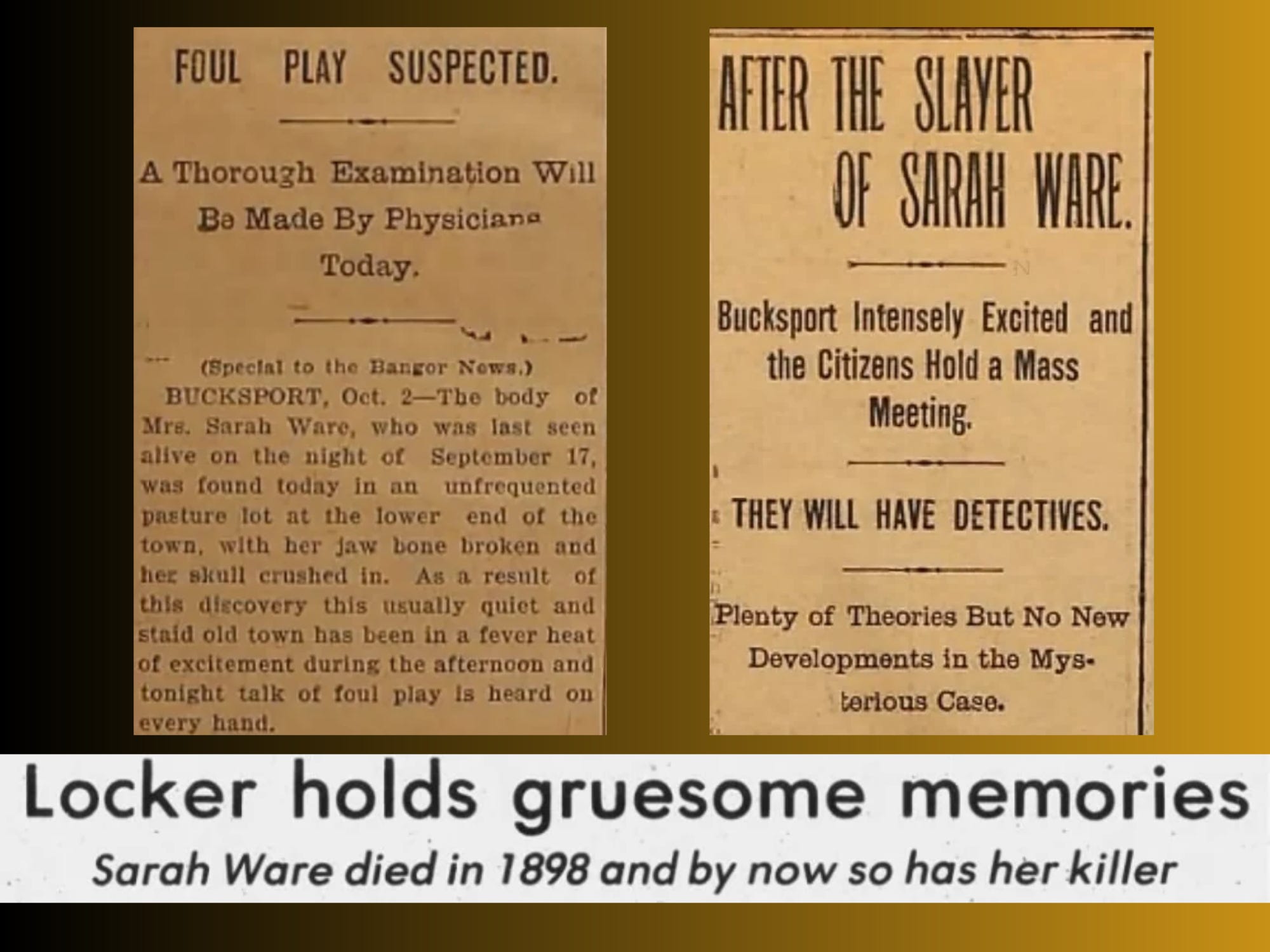
Ware was last seen alive on Sept. 17, 1898, when she went to visit some family friends and then stopped at a general store on her way home. There’s no definitive proof about how, exactly, Ware was murdered in September 1898 - or who did it - but on Oct. 2 of that year, Ware’s brutally beaten and badly decomposed remains were discovered in some bushes off Miles Lane in Bucksport. When authorities moved her body, her head fell off.
Newspapers at the time ran countless stories about the murder and subsequent investigation and eventual trial. “This usually quiet, staid old town has been in a fever heat of excitement during the afternoon, and tonight talk of foul play is heard on every hand,” wrote the Bangor Daily News shortly after Ware’s body was discovered. Despite breathless promises that Ware’s killer would be uncovered any day, by mid-November, there had been no further breakthroughs in the case.
To this day, there’s no real answer to what happened, though there are a few theories. Emeric Spooner, a writer, historian and librarian in Bucksport, said that he believes that Ware was beaten to death by a man named William Treworgy, for whom Ware had worked as a cleaner and who newspaper reports at the time claimed had a “bad temper” and was a drunk.
Spooner thinks Ware went to ask Treworgy for payment for a job she’d done for him, and he flew into a rage and allegedly attacked her with a hammer, killing her. Four years later, in 1902, Treworgy was actually charged with her murder, but the prosecutor’s case against him fell apart thanks to a witness recanting, and he was found innocent by the jury.
Bucksport journalist Sharon Bray believed that Ware was beaten to death, but not by Treworgy - instead, by one of the men she was playing cards with the night she died. When two of the men got into a fight, Bray said Ware was unintentionally struck in the head with a bottle and was killed, and Treworgy was paid to dispose of the body despite not having been responsible for her death.
News reports at that time claimed that Ware was a woman of a certain kind of character. She smoked cigars, the Bangor Daily News reported, and she caroused with “unsavory” men and may even have worked as a “lady of the evening.” Such reporting may have colored the way in which the public viewed the case, though sadly, it wasn’t uncommon then for women to be blamed for their own abuse or worse - it even still happens sometimes today.
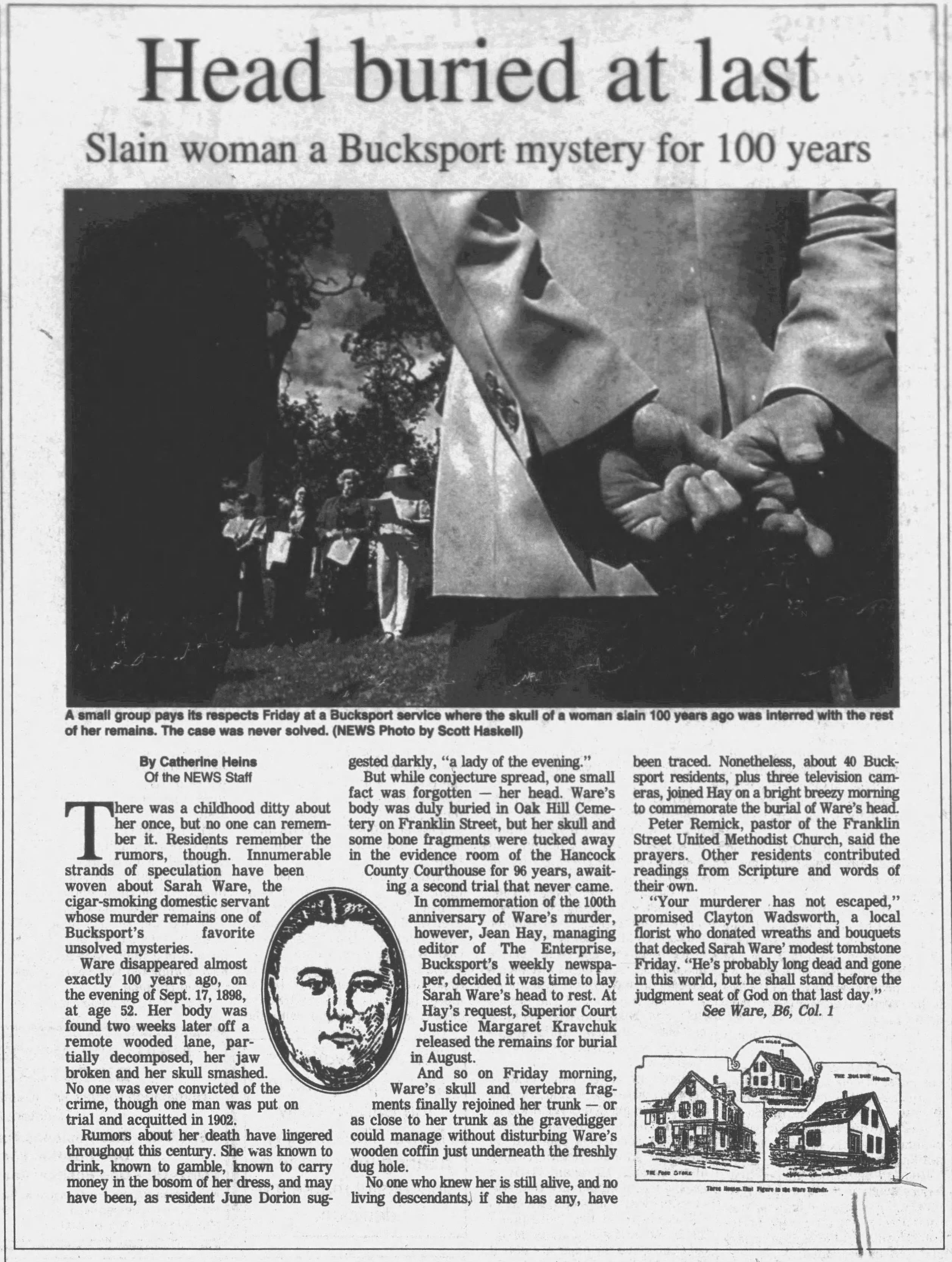
At some point after her death, her body was buried at Oak Hill Cemetery. Her head, however - that stuck around above ground.
For more than eight decades, poor Sarah’s head - eventually just a skull and jawbone - sat in an evidence locker at the Hancock County Courthouse in Ellsworth, along with her few remaining possessions, including a handbag, a raincoat and some jewelry. It stayed undisturbed the entire time, and was eventually forgotten.
In 1982, maintenance workers at the courthouse were searching for an old ledger for an audit when they opened a dusty old fireproof box that had survived the 1933 fire that leveled much of downtown Ellsworth. There was no ledger in there. There was a skull.
Shocked by their discovery, Sarah Ware’s head quickly became a bit of an urban legend around town. A former clerk at the courthouse recalled people coming in to inquire if it was actually true, though it’s unclear if anyone actually got to take a look at it. It brings to mind another wild, true tale of a Mainer - that of Elmer McCurdy, the Knox County native who went on to lead a life of crime in the western U.S. before being shot by police in 1911, and whose body ended up mummified and on display in sideshows and haunted houses before being being laid to rest in Oklahoma in 1977. That’s another story for another time, however.
Sarah’s head stayed at the courthouse for another 16 years, until 1998, when 100 years after her death, Jean Hay, editor of the local newspaper, the Bucksport Enterprise, took the initiative to finally bury Ware’s head along with her body. Judge Margaret Kravchuk released the remains from evidence, and a graveside service was held on Sept. 11, 1998. There were no known living descendents, and despite more than a century’s worth of questions, the case of Sarah Ware’s murder had finally grown fully cold.
The justice system may have failed Sarah, but she still remains a local legend. Some claim that Sarah’s spirit wanders along Miles Lane, where her body was found and where Bucksport’s school athletic fields now lie. Some say that on misty nights she floats along the shores of nearby Silver Lake. And some say she can be spotted at Oak Hill Cemetery, where for nearly 100 years her body was buried before being joined by her head. As far as Maine ghost stories go, it’s a real one.