
I went to the woods to make a lot of money
The story of Joseph Knowles, the Maine survivalist who made most of it up
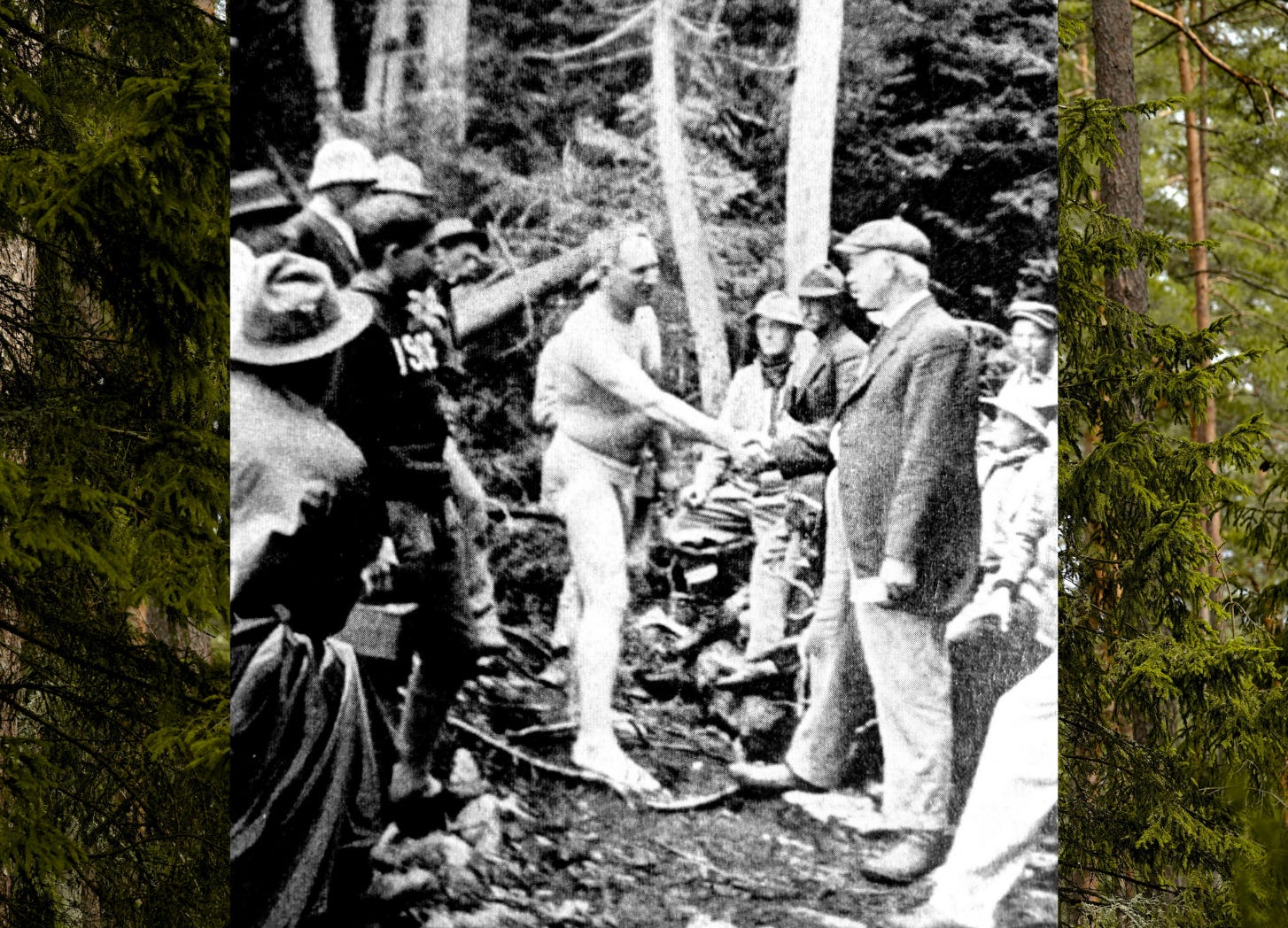
200,000 people reportedly greeted Joseph Knowles when he arrived in Boston in October 1913, eager to see the man who’d spent more than eight weeks alone and mostly naked in the Maine wilderness, living off whatever he could hunt and forage in the woods.
When Knowles disappeared into the woods near Spencer Lake in far northern Somerset County in August of that year - surrounded by photographers and reporters - he was wearing nothing but a white cotton jockstrap. He told the crowd that he intended to document his experiences by leaving accounts written in charcoal on strips of bark, to be deposited and picked up in pre-arranged locations and then published.
By the time he emerged two months later just across the Maine border in the Eastern Townships of Quebec, wrapped in a bearskin and sporting shoes made of birch bark, he was a national phenomenon. His dispatches appeared in newspapers nationwide, telling tales of his wandering naked through the woods, surviving off berries and fish, crafting makeshift clothing and shelter out of bark and grass, and rubbing two sticks together to make fire.
The stories captivated a public already fascinated with characters like Tarzan, adventure novels by Jack London, and rugged figures like Teddy Roosevelt. To them, Knowles was at once a prime example of manliness, conquering the wilderness with only his skills and his wit - and an escapist fantasy of being stripped down to our animal instincts and becoming one with nature. A book, “Alone in the Wilderness,” soon followed, and then a movie of the same name, starring Knowles as himself. It was all quite romantic and exciting - and lucrative for Knowles, who at one point made $1,200 a week in speaking fees.
As the years went on, though, it became clear that many aspects of Knowles’ stories were a little far-fetched. Deeper reads of his memoir began to turn up inconsistencies. One journalist managed to examine the bearskin Knowles was wearing when he emerged from the woods and discovered bullet holes in it, and found a local trapper who said he sold Knowles the skin for $12. Knowles claimed to have trapped a bear in a pit and then killed it by beating it with a log - a feat seasoned hunters and trappers said at the time was near-impossible without some form of help or specialized tools.
It eventually emerged that Knowles - who claimed to have grown up in Maine and had once worked as a trapper and logger - and some colleagues had actually planned the entire stunt. Knowles worked as an illustrator for the Boston Post, the newspaper that first published his dispatches, and had concocted the plan to spend two months in the woods with a fellow Post journalist, Michael McKeough, who reporters speculated wrote Knowles’ memoir himself.
Furthermore, a journalist from a rival paper, the Boston American, made the bold claim that Knowles hadn’t survived alone in the woods at all, but instead had spent two months in relative comfort in a remote log cabin not far from where he first walked into the wilderness. Much later, a New Yorker article in 1938 confirmed that allegation, and offered further proof that McKeough was indeed the one who actually wrote the book. Knowles, however, did provide the illustrations. One thing was true about him: he was a gifted artist, and his charcoal sketches of his time in the Maine woods - and the illustrations he did in his later years of the American West - were by far the best things he ever produced.
As you might expect, Mainers reacted bemusedly to this latest story of a guy from the Boston area disappearing into the woods to show how badass and spiritually enlightened he is. More than one newspaper account scoffed openly about what a “great accomplishment” Knowles had achieved - like living in the woods for a couple months was some unprecedented feat. Making a big public deal about it was even worse. And then there was the greatest of sins: by claiming he’d trapped and killed a bear in September, Knowles had violated Maine law by hunting out of season. Is there anyone more reviled by outdoorspeople in Maine than a poacher?
Joseph Knowles is largely forgotten today. His story reads more like other carefully constructed hoaxes and faked memoirs from throughout history, both those based on a kernel of truth and then greatly embellished, and those entirely fabricated. There are many examples of white people pretending to be Indigenous, for instance, like Tim Barrus, who claimed to be a Navajo man named Nasdijj, or Archibald Belaney, a Canadian man who adopted the made-up Apache persona Grey Owl. Others pretend to have salacious backgrounds, like Michael Pelligrino, who claimed to be a forgotten son of the Gambino crime family and made $500,000 off a book deal, or James Frey, who fabricated nearly everything in his bestselling memoir, “A Million Little Pieces,” about his supposed years of substance abuse. One writer even managed to tell two fake stories: Laurel Rose Wilson, who pretended to be a victim of a nonexistent Satanic cult in her book “Satanic Underground,” and then years later, under a different assumed name, pretended to be a Holocaust survivor in another fake memoir.
In all of those cases, they seized upon some behavioral, cultural or historical phenomenon that grabs people’s attention and imagination (and their wallets, hopefully). In the case of Knowles, it was the near-universal appeal of the survival story, and of the fascination people have with the mysteries and dangers of Maine’s North Woods. Those stories remain popular to this day, whether it’s the unclothed survivalists on “Naked and Afraid” or Bear Grylls drinking his own pee or eating bugs on any of his TV shows.
Legions of people head into the woods in Maine each year to hunt, fish, paddle, hike and temporarily disappear into the largest undeveloped forest in the eastern U.S. Most return home safely; some get lost and nearly die, like 12-year-old Donn Fendler, as depicted in his (100 percent true) 1939 memoir “Lost on a Mountain in Maine”. Still others deliberately disappear in order to escape society, like the North Pond Hermit, a.k.a. Christopher Knight, who spent 27 years alone in the woods not by hunting and foraging, but by stealing food and supplies from nearby lakeside camps. Sure beats Knowles’ two months.
It’s much more thrilling and romantic to think someone is truly surviving in the woods, hunting and gathering and living off nature, than it is to think they’re performing for the cameras, or merely hanging out in a well-stocked cabin until it’s time to come back to society and get famous. The real stories - the ones that are not only true, but are truly incredible - often don’t end up getting told at all.


The skeeters, minges;blackflies; dragonflies, & no-see-ems would've pulverized him into massive itchy welts!
Great story! I never heard of that guy before.