

INTERVIEW | Caroline Bicks: The meaning behind the monsters in the Stephen King archive
Her new book sheds new light on his iconic early novels

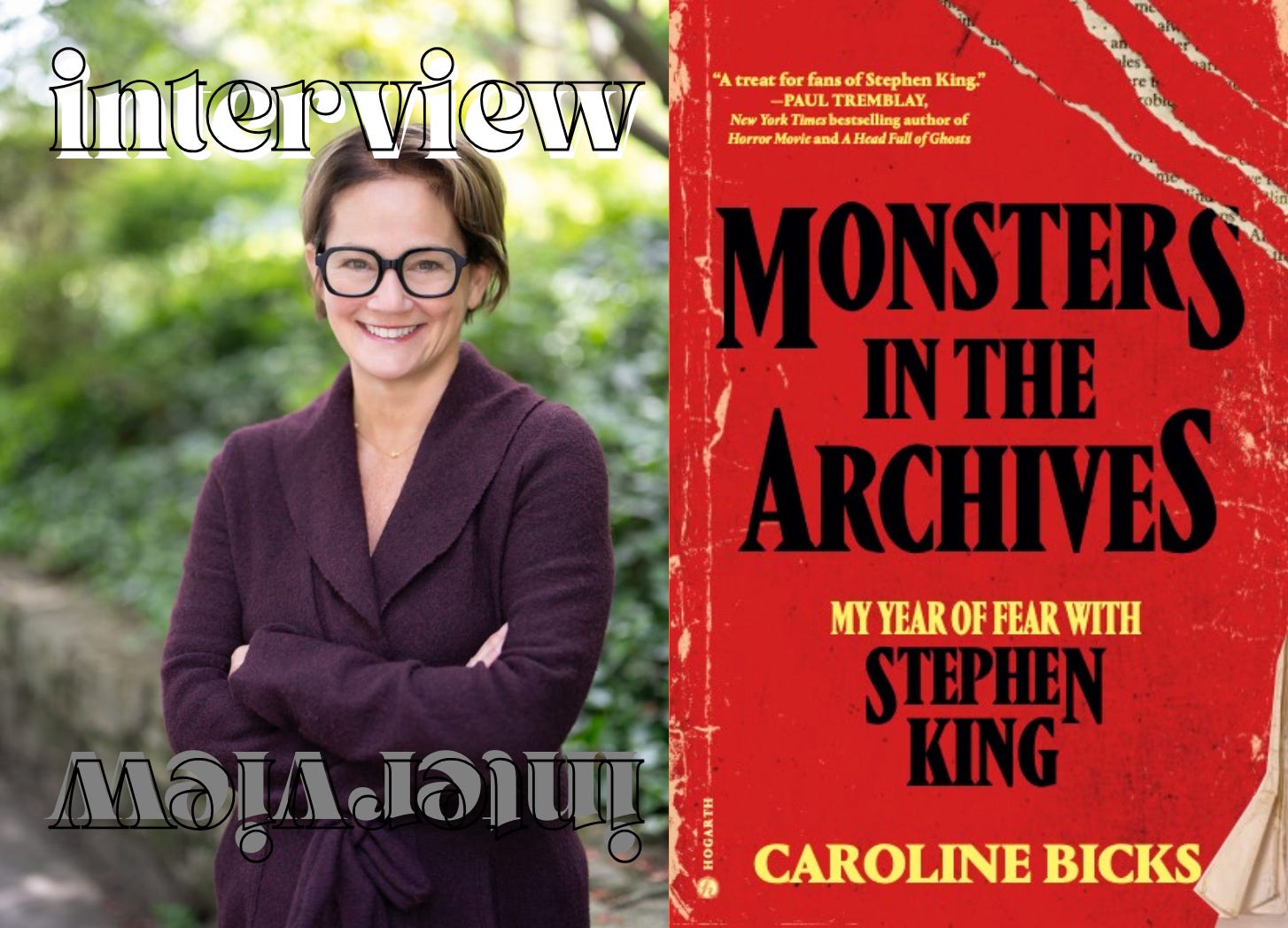
For a year between 2022 and 2023, University of Maine English professor Caroline Bicks spent hundreds of hours behind the iconic wrought-iron gates of the house at 47 West Broadway in Bangor – the first person invited to access Stephen King’s personal archives since it was moved in 2018 from UMaine’s Fogler Library to King’s former home in Bangor.
Bicks, who came to Orono in 2017 as the inaugural Stephen King Chair in Literature, may be best known as a Shakespeare scholar - but as her title suggests, she shares equal amounts of fascination with the Bard of Bangor as she does the Bard of Avon.
Bicks poured over first drafts, manuscripts, correspondences, notes and ephemera associated with early King books like “Carrie,” “The Shining,” “‘Salem’s Lot,” “Night Shift” and “Pet Sematary,” in search of insight into the process, meaning and mind behind such legendary horror novels. The resulting book, “Monsters in the Archives: My Year of Fear with Stephen King,” – out on April 21 – doesn’t just document that exhaustive research, but also sheds exciting new light on books that have become integral to American literary and popular culture.
I spoke with Bicks about her year in the archives, the ways in which Shakespeare and King are similar, and the all eerie, creepy coincidences that popped up as she did her research - only appropriate, given the subject matter.
Why did you choose only to focus on King’s works from the 1970s and early 1980s? With such a massive bibliography you obviously had to choose just one era - but why that one?
I wanted to have a personal connection to what I was doing. I can analyze Shakespeare until the cows come home, but I’m not bringing my own personal story to it. Those 1970s books were my first King books and were the ones that have stuck with me for my entire life. They authentically terrified me when I was kid. And as a literary scholar, who studies the power of language, I wanted to really understand exactly how he crafted it. And, of course, to have the opportunity to have access to these archives, it was such a gift. To be one of the first people allowed into the archive in Bangor, and to see all these manuscripts lined up next to each other… it was just incredibly special.
I also wanted to write a book that was for a general audience; not something for academic readers. I hope they enjoy it too, of course, but I wanted to write something for everybody - from King fans to anybody who is interested in how books get written. And I feel that those ‘70s books have a particular cultural capital. They keep getting made into movies and TV shows! Why do these books have such staying power after 50 years? So to have this chance to really study them and see how, say, a character like Carrie developed, and how much she changed, was extraordinary.
I also was struck by how much Carrie changed from his early drafts to the finished product! What was the biggest revelation to you, in terms of how a book or character changed from first draft to final?
Carrie was definitely a big one - I don’t think that if she had stayed the way she was at the beginning she’d have become an icon. It’s hard to feel bad for her, in the first draft. Really though, I would say “The Shining” research was the one that really blew my mind. The first draft was called “The Shine,” which I don’t think a lot of people know. I got to see that very first draft, which has a very different ending from the published book. Wendy is called Jenny!
That was most shocking to me, because if I had to pick a favorite King book, “The Shining” would be it. I think it’s genius. Not just because it’s so incredibly scary, but because it’s just so psychologically compelling. This is why Stanley Kubrick’s film, it’s like - fine, it’s great, but it’s not the book at all. The book is about intergenerational trauma. Seeing where he originally thought the book would go, and then where it did go, was really profound for me. And I did learn that he was imagining a Shakespearean tragedy when he wrote it. The first draft was divided into scenes and acts! There were points when I was doing my deep dive into “The Shining” that I had to take a step back, because my head really did kind of explode at one point - the eerie coincidences I was having, these revelations about how the story changed.
I know I’ve had lots of those kinds of eerie experiences while reading King books. I remember reading “11/22/63” right after it came out and literally looking out the window of my apartment in downtown Bangor and seeing exactly the spot in town King was describing in the passage I was reading. It was genuinely unsettling. Where do you think that comes from? Is it just your mind finding the connections and giving them outsize meaning?
It’s really creepy! I mean, I take Route 15 from my home to the archives in Bangor, which passes through exactly where the Kings lived in Orrington when he was inspired to write “Pet Sematary.” I would drive that road every time I went there. And then there’s the fact that, in the book, Louis Creed also moved from a city to rural Maine to work at the University of Maine, which is exactly what I did. And that the copy of “Pet Sematary” I got at the Big Chicken Barn was the same edition I read as a kid. I don’t know if I’m looking for those connections, or if it’s the universe trying to tell me something, but whatever it was, it freaks me out.
You allude to this throughout the book, but I’m curious - as a Shakespeare scholar, and now as a Stephen King scholar, what DNA do you think the two of them share? They’re separated by centuries, but I suspect there are more similarities to them as actual writers than people might expect.
One thing that I always come back to is that they both are such intentional craftspeople. Both of them understand the sound of language, and the way that it sticks in your head. Shakespeare’s doing it because he’s writing for theater, of course, but the end result is similar. One of the things that was really a revelation for me in the early conversations I had with King was his saying how he has to think about how the words are going to “clang” in the reader’s ear, and how it actually sounds to them. And I think both Shakespeare’s and King’s words often have the same effect on readers. There’s something quite sensory about how they both put words together in such a way that it activates human emotion - fear, humor, grief, rage.
Both wrote for popular audiences. Not only are they incredible craftspeople, but also they are highly accessible. The two certainly are not mutually exclusive. It’s not like Shakespeare was revered as this highfalutin writer in the 16th and 17th centuries. He was raked over the coals by the University-trained elite, who said he’s just some upstart crow. I see a lot of similarities in how they were treated by the elite.
You hook upon a really telling line from one of your interviews with King in the last section of your book, on “Salem’s Lot”: he says, “You come to Maine through rock.” I would love to hear what you think that says about Maine - a place, a people, an idea.
That was one of my favorite conversations that I had with him. I had just visited Durham, which is where he and his family moved when he was 11 years old. I didn’t really appreciate it until I talked to him how important that town was to him. It was the first time he’d lived in a rural community. He talked about how he hated [Durham] at first, and then fell in love with it - not just things anybody loves about a town, like your favorite teachers and friends, but the hard stuff too. And, especially, the people. He loved the town gossip. He loved the regular people, with all their quirks and specificities. I think that’s why towns in general really are also characters in his books. “‘Salem’s Lot” is a love letter to Durham.
So when I think about what “You come to Maine through rock” means, I think about how apt a metaphor rock is for Maine. Rocky-minded Mainers, you know, who are a little rocky, a little tough to get to know. “We’re not gonna make it easy for you to know who we are.” It doesn’t mean you never will, but - you’ve got to work for it. You’ve got to be genuine. There’s a steely - rocky, maybe - kind of pride in Maine. Rock is part of the landscape, with all this granite and the rocky coast. And, in terms of King’s work, I think there’s a sense that if you start poking around beneath the surface, you’ll find something much older and denser and harder beneath the soil. There’s an exterior, and then there’s an interior that’s hidden.
It’s quite a metaphor, if you start thinking about it!
Of course, as I was sounding off on this, King didn’t stop me, but he did say “You don’t want to eviscerate a metaphor.” Which, of course, is true.
There are two Maine book launch parties for “Monsters in the Archives” next week - at 6:30 p.m. on Tuesday, April 21 at Orono Brewing Company in Orono, and at 6 p.m. April 22 at Longfellow Books in Portland.
That must have been a fun interview. She sounds like a real person.