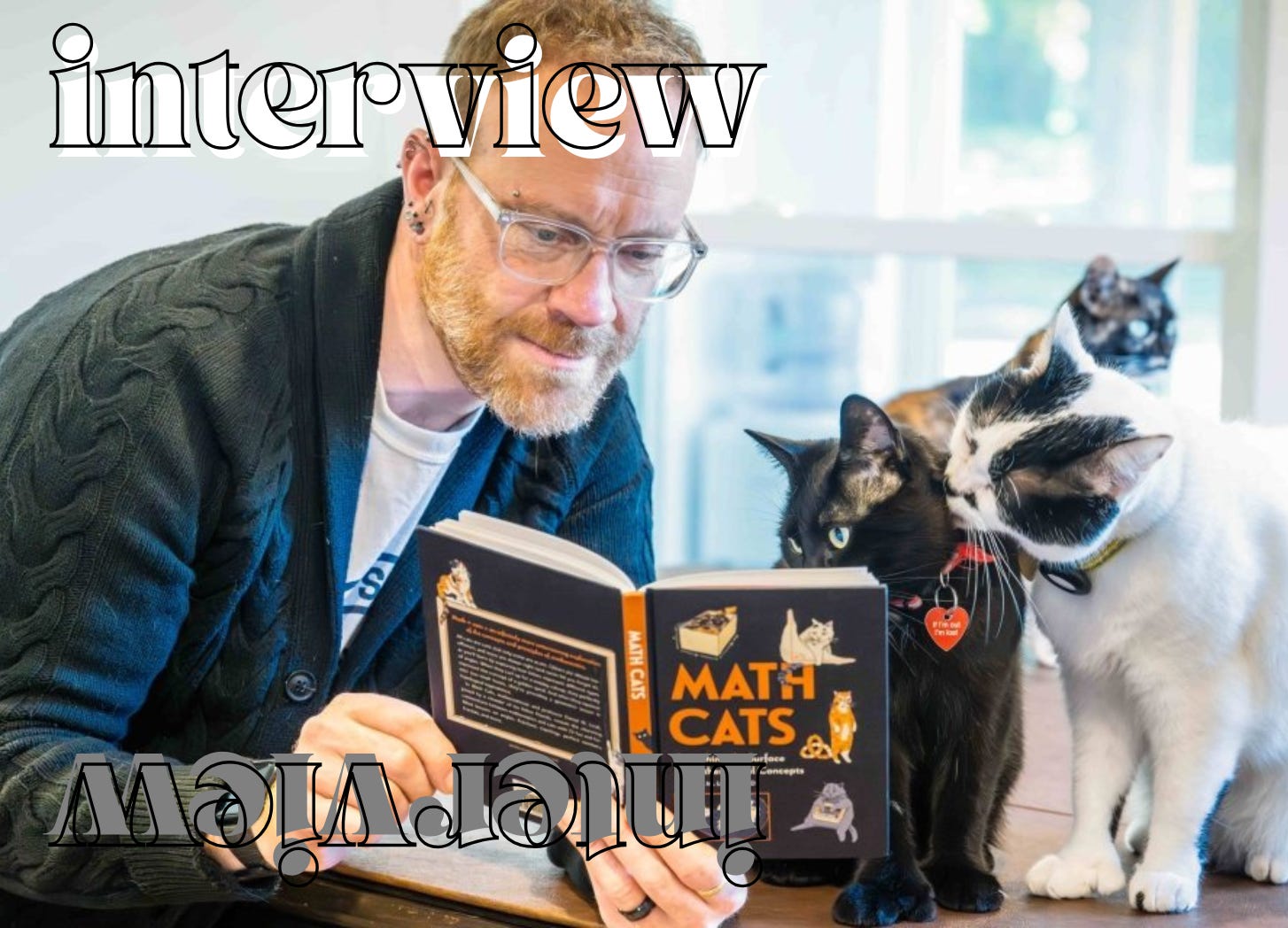
INTERVIEW | Daniel Look: Math anxiety and the 'cosmic angle of regarding'
Spongebob lives in a mathematically incorrect pineapple under the sea

For most of my life, I’ve feared math. I don’t mean paying bills or figuring out a tip or anything like that - I mean math math. Algebra. Geometry. Numbers and symbols on a piece of paper, totally disconnected from my reality. I look at them, and suddenly, I’m 11 years old, paralyzed with anxiety, unable to make sense of any of it. I simply do not speak the language. I can feel the palpable annoyance of my sixth grade math teacher as she leans over my shoulder to tell me I’m wrong. I long to run outside and read a book or practice my clarinet or do literally anything else. Everyone tells me I’m a smart kid, but in math class, I feel truly stupid. I will get a few Fs and barely manage C’s and D’s in math throughout my entire educational career - I’ll get A’s in everything else, mind you - and as soon as my second math requirement in college is done, I will give math two emphatic middle fingers and leave it in the dust forever.
Except that as I get older, my total rejection of math will begin to morph into something like curiosity, or perhaps jealousy. It’s not fair that an entire branch of knowledge is inaccessible to me! Why shouldn’t I be able to understand some of these concepts? A large part of my identity is wrapped up in she’s a smart kid. One night in 2007, while sitting around the living room in the beautiful hippie Orono house I shared with a variety of graduate students and visiting professors, a loquacious guy with green hair and a math PhD explained to me [I’m wildly paraphrasing] that math is not numbers on a page, but the mysterious backbone of the cosmos, that gives structure to reality and reveals unceasing wonders. It’s not impossible - in fact, it can be fun. While I wouldn’t say I’m “good at math” now, I can say that I could explain a handful of formulae or concepts in math and wouldn’t be completely wrong and wouldn’t have a panic attack while doing it. I could even win on Numberwang. That’s big progress for me, folks.
Nearly 20 years later I was doomscrolling through Instagram and stumbled across a post about a book released last fall called “Math Cats,” which explains complex mathematical concepts through cats being cats and a breathtaking array of puns. The author, Washington County native Daniel Look, was the green-haired guy who changed my entire perspective on math that night in 2007. I tracked him down at St. Lawrence University in Canton, New York, where he is a math professor, and last week we talked about growing up Down East, cats, Spongebob and, yes, math.
First off, tell me about growing up in Harrington. Was it all blueberries and lobster? What was your family like?
I would say we were like most other families in Washington County - seasonal jobs, fishing industry, agriculture, logging, working class. I had a grandfather who was a lobsterman. I had a grandmother who packed sardines. My dad was an over the road truck driver, and my mom packed fish too. Fish packing was big business. In fact, there’s this relatively famous sculpture of a woman sardine packing that you can buy somewhere Down East. That’s my grandmother.
Anyway, I’d say I had a very typical childhood for someone in that part of Maine. Spent a lot of time outdoors. Did a lot of the things you’d expect. I would say that advanced education probably wasn’t a primary interest of most of my peers. Now, to be clear - my parents were very, very smart and very, very encouraging. My dad was constantly reading. He could fix anything. I think there’s a very strong tradition of Mainers really valuing learning even if they don’t pursue an education. But I do think that a lot of people had their career paths picked out for them very early on - fishing, agriculture, whatever it might be. And then there’s me, who as soon as I knew what college was, I was like “That’s for me!”
How did you know that math was your thing? It doesn’t seem like you grew up in an environment that produces a ton of mathematicians!
The only person in my family that went to college was my other grandmother, who got a degree and was a teacher. She noticed from a very early age that I was the one that loved to read, that preferred music and video games and wasn’t exactly cut out to be a mechanic or something. That said, I don’t remember having a particular love for math at the time, even though that was my best subject. It was more just a love for learning and being in school.
I think the thing that really moved me toward math as a career was the fact that my dad went to the same church as the president of the University of Maine at time, Dale Lick, who was a mathematician. He gave me a copy of an algebra book he had written, and he signed it “To my fellow mathematician.” I was 12, and I was like, “OK, that’s what I’m going to do.”
I too was a huge nerd in school, but for me, it was all about writing and reading and social studies and history. Math was the one area where I just could not make heads or tails of it. I completely dreaded it. It felt like a punishment. You’ve probably met a lot of people in your career that have similar feelings about math. What do you say to people like me, who want to understand it, but feel like they are completely incapable?
The first thing I ask is, “Who hurt you?” [laughs]. Seriously though, while this isn’t true for everybody, I think for a lot of people, it’s all about that one teacher who made you feel dumb, or who simply didn’t care to try to help. I also think a huge part of it is just how we teach and approach mathematics. We put so much focus on algebra, which is just not something most people will ever use. And we don’t tie our teaching of it to reality - or when we do, it’s not helpful. Some teachers will try to compare, say, graphing a parabola to how you’d shoot a basketball. Nobody is using math to make their shot better. They’re just playing basketball. It’s not actually helpful. In fact, you’re just trying to gaslight me into thinking math is useful by pretending that the quarterback is using it to throw the football, when we all know they’re not. We don’t do a good job of selling it - and when we do, it’s just not relatable or helpful at all.
That’s my biggest complaint - we give people the worst stuff to learn, and then if you go off track, then that’s basically the end of the line. We’d never teach reading that way. We wouldn’t say, “Oh, you hate reading Shakespeare. Guess that’s it for reading for you!” That’s almost a point of pride for some math teachers - my class is so hard that only a few of you will make it to the end. That’s incredibly discouraging! English teachers and professors want you to love reading. Math should be the same. And then there’s the whole fact that women and girls have been historically made to feel like math and science aren’t for them. That has really, really hurt us. I think some of that is starting to change, but there’s still a long way to go.
Is that why you wrote a book about how cats can help explain complex ideas in math?
Yeah, absolutely! If I’m in a bar or something, that’s how I’m going to talk about math if it gets brought up in conversation. Especially if the first thing out of that person’s mouth is “Oh, I hate math.” I can’t tell you how many times the first thing someone says when I tell them I’m a mathematician is “Oh wow, I hate math!” I definitely don’t want that to be the case.
My whole thing is to come up with examples that require zero equations that you can explain at a bar. For instance, did you know that if you have 26 people in a room, there’s a more than 50 percent chance that two of them have the exact same birthday? You might think you’d need 170 people for that to be true, or half the dates in a year, but that’s not true. It’s a probability question. Or, for example, the fact that if you look at a map, you will find that you will never need more than four colors for each state or country. Four is always sufficient. That’s a really hard proof, actually, the four color theorem. I don’t know how to do it. But I don’t need to know how to do the proof to enjoy the theory.
I’ve actually heard of that one! The four color map one. Now that I think about it, there’s a bunch of things like that I’ve heard of, and that I think I kind of understand! Maybe I’m not as scared of math as I think I am.
It’s fun math! You don’t even need to be good at math to understand it, and it’s such a great way to start to understand the larger concepts behind things. Look at the Fibonacci sequence. The spirals in it always work out to consecutive numbers, and it is everywhere in nature. The pine cone, the state flower of Maine, that’s got Fibonacci spirals. So doesn’t a pineapple. That’s how you know Spongebob doesn’t actually live in a pineapple under the sea - it doesn’t have the right number of spirals. It may look like a pineapple, but that’s not a pineapple.
Spongebob is a fraud! Or, at least, whoever he bought his house from is. I know you’re such a huge pop culture fiend, and that’s a huge part of how you communicate and educate in a way that’s relatable. Why did you choose cats as the way to explain math concepts? Why not, say, dogs? Cartoon characters?
With cats, as it turns out, I was actually approached about doing this book. An editor for Running Press knew me and knew I loved cats [Ed. note: Dan and his wife have four cats; Conan T. Cat, Meow Meow, SpaghettiOs, and Mrs. Waffles]. He reached out to see if I was interested in doing a book on math-cat memes from social media, which morphed into “Math Cats.” In terms of dogs… I do joke about writing a follow-up titled “Pupular Mathematics.”
Really, though, one of my favorite things to do when I’m talking to someone, anyone, about math, is to ask them to name a topic or subject - literally anything - and I’ll find some way to connect it back to math. Books, for example - there’s a field of study called stylometry, where you use statistical analysis to analyze writing. I did an analysis of all the Nancy Drew novels - there are over 600 of them, and they are written by tons of different people under the same pen name. We put all of them through a computer and went hunting like a truffle pig for all the interesting factoids we could pull out of it. That’s math!
Sometimes all it takes is to just change the angle of attack with how you think about things. Suddenly it starts to make sense.
It’s what H.P. Lovecraft calls your “cosmic angle of regarding.” Side note: I’m getting a new tattoo next week, and it’s inspired by that. I have 20 tattoos and they’re all math tattoos. I also have a tattoo of President Andrew Garfield proving the Pythagorean theorem. I love asking people if they want to see my Garfield tattoo, and because I’m the cat guy, they’re surprised to see it’s all just geometry.
Last question: Do you make it back to Maine very often? How has Washington County changed from when you were growing up there in the 1980s?
I do! Every year I go see my extended family in Old Orchard Beach, and my brother lives in Jonesport, so there’s definitely still a connection. I think the thing that really surprises me in a lot of ways whenever I drive through Harrington or the rest of Washington County is how little it’s actually changed. It feels really nice to me, oddly enough. I’m sure there are little things that have changed, but it really does not feel all that different from when I was growing up. The landscape is pretty much exactly the same. I find that really comforting.


Okay, short story. In college, my father wanted me to go into architecture, so I was taking calculus, trig, physics and stuff like that. Then I would up going into commercial art (sorry Dad). That said, in taking my second course in calculus and not doing very well, my professor was trying to figure out how to help me and he figured out I was visually-oriented. We were graphing out parabolas and ellipses, so my professor talked about the reflective principal of paranormal. This says if you take a parabola, rotate it 360 degrees, build it out of shiny metal, then point it at the sun, every ray of light that hits the inside is reflected directly to the vortex. It becomes a sort of super-solar-collector. That's all I needed, my grade immediately rebounded.
