


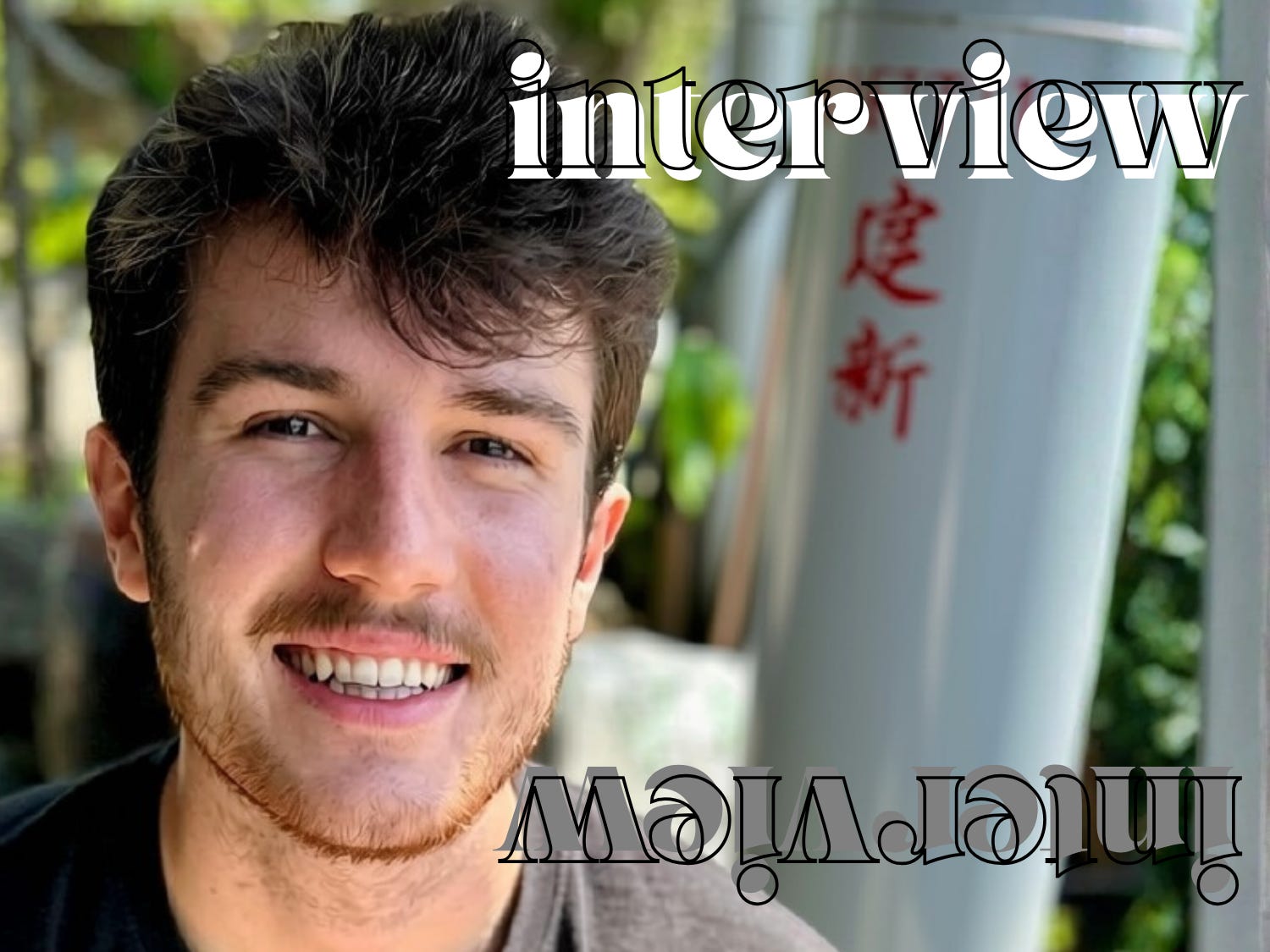
When I asked Michael Senko, a PhD student in linguistics at Stanford University, if he thought I had a Maine accent, we shared a slightly knowing smile. We both knew I didn’t. Despite growing up surrounded by Maine accents, I simply don’t speak that way. Well, unless I’ve had a couple drinks around a bonfire. Or I want the guy at the garage fixing my car to like me.
Senko would know - he spent most of his summer in Eastport, conducting hours and hours of field research into the regional characteristics of the Maine accent Down East, specifically far eastern Washington County. Despite Down East arguably being the epicentre of the Maine accent, Senko said that there’s been virtually no sociolinguistic research done on the accent and ways of speaking of Mainers outside of Aroostook County and southern Maine.
Senko is aiming to change that with his work at Stanford, which has one of the top linguistics programs in the world. Armed with a built-in knowledge of Maine - he grew up in Massachusetts, but he came to Maine all the time as a kid, and his parents now live in the Augusta area - he’s hoping to document the unique characteristics of how folks Down East talk. We talked last week about accents, identity, and adding an extra “r” to the end of words like “pizza.”
First off: why the Maine accent? There’s such a vast array of topics you could have picked for your PhD. Why this one?
I mainly work on language variation and change, specifically in sound structure, in the phonetics and phonology area of linguistics. Typically, people who study that locate their studies in specific communities, because we want to understand the social motivation for sound change… I also really, really wanted to do fieldwork in my PhD. That was a top goal. I was trying to think of places to do it, and I had all these family members on my mom’s side from Maine. They had all these very interesting features in the way they speak, like the intrusive R.
That’s just like adding an R where it doesn’t belong, right? You’ll add an R at the end of something if there’s a vowel at the end? I had a middle school teacher who would pronounce pizza as “pizzer” or Toyota as “Toyoter.”
Yeah, exactly. That was something I thought of so clearly, because it’s a very interesting feature in general. It follows these really specific rules. I also came to realize that there just hasn’t really been all that much work done on Down East Maine in general. People have looked at Aroostook County, but then all the rest of the work came from southern Maine, which is really very limited. There’s really been nothing done in terms of sociolinguistics in that entire region, which is actually pretty rare. People have studied very rural, relatively isolated places across all of North America, and especially in the US. And yet in Washington County? Basically nothing.
It’s arguably one of the most well-known regional accents that a lot of people can pick out, but Down East, it just simply hasn’t really been studied. That seems wild to me!
New England as a region is probably the most studied region in American dialectology, which just makes it more surprising that there’s this huge chunk of Maine that people just haven’t really looked at. You can look at atlases of North American English, and you can look at the dialect regions that they draw on, and some of them just leave out most of Down East, full stop. They assume that we know things about the Maritimes, and we know things about New England, and so they assume that Down East must just be some sort of combination. That’s a big assumption.
If I were to think of the place where the Maine accent is most prevalent, I would immediately think of Washington County, along with other parts of the coast. Why has it carried on more prominently in those parts of the state? Is it simply isolation? Or is there some other reason?
It’s a combination of things. Isolation definitely plays a big role, but that’s obviously not the full story, because something that I find really interesting about Eastport is that for most of its history, it actually has not been a very isolated place. It was a commercial and shipping hub for a large part of the East Coast, and even internationally. There were boats and people coming into Eastport for hundreds of years from all over the place. It wasn’t like they weren’t having any interaction with people who weren’t from there.
One thing that people have looked at is that the closer you get to a demarcated border, like the Maine-Canada border, is that the accent can actually become stronger. The dialectal features can become a way of sort of signifying or marking differences. As you get closer to a border people, tend to emphasize the features that say, “This is us.” I think a big part of it is social and cultural. There is a whole separate project to be done on the use of the word Down East across all of Maine.
People get real fast and loose with it, in my opinion.
People that I was talking to in Eastport felt very sure that they were Down East, and that other parts of the state were not.
Do people use their accents as a way to signify who they are and what they care about?
You can use the phonetic properties of language to express the concerns of a community. And if a concern of a community is being this authentic Down East person in a world that is changing so much, then one way to do that is through language. Eastport itself has this deep, ingrained pride, which I’m sure many other communities in Down East do as well. They are consciously very proud of where they are from.
I think there’s pride, and almost like a defiance in being a Mainer. There’s two sides to that, of course, because, that can also mean that you are resistant to outsiders, but I also think there’s a legitimate distrust of people that come in with lots of money and power and try to take advantage of us, or exploit us. Mainers have every right to be skeptical of moneyed interests from away. There’s a trust that has to be earned. But on the other hand, it’s like, OK, slow down, buddy. This nice middle-class family from Massachusetts just wants to live here too. They’re not the problem. I see both sides of that equation.
When I was conducting these sociolinguistic interviews, I asked all kinds of questions, not just so I could hear the way they speak, but also because I was just incredibly interested in what they had to say. Within the same interview, when I would ask about people from away, people would at some points be so defiant, as you said, and so critical and almost, like, unapologetically opposed. But then other points also would be, like, oh, well, you know, my neighbor actually isn’t from here, and she’s super nice. There’s an interpersonal warmness that I also think is endemic to Maine. Like, if he treats me all right, then I’ll treat him right too.
You often hear that these little regional accents all across the country are flattening, and that some of the diversity of the way people speak is sort of disappearing. What’s your take on that? Is it inevitable?
Language varies within people and across communities and across regions, and it’s also constantly changing. Across the country, people seem to be converging with some specific features. But the thing that they are converging towards is also changing itself… It’s not like it just stays this monolithic, standard perfect English or whatever. It also is going through all of its own changes.
When we look at local communities, we can identify local features and see that they are receding over time. But I think there needs to be a lot more work within linguistics at analyzing what people are actually shifting towards. That, I think, is a question that we actually don’t have a lot of data to answer right now. That is the reason why I stay optimistic. It just makes me sad when people characterize it as this monolithic, unchanging thing, because I promise it’ll keep changing.
Is there a particular piece of slang or a colloquialism that you heard in your research that either you just enjoyed, or that was unique in some way?
I really love the phrase, “right out straight.” I’ve found myself saying it. I find it really useful. I love that. One thing I thought was also really interesting was the inhalation to say yes.
Oh yeah, like when you kind of inhale as you’re kind of saying yes, right? I actually do that, even though I really don’t think I have much of a Maine accent.
That one is really interesting because some people would use it totally unconsciously and not be aware of it at all. I also thought it would be more reserved for the older speakers. But it wasn’t. A lot of people could also comment on it as a thing they do. I would be really curious to know, for the speakers who seem to use it unconsciously, when do they use it, and when do they actually say “yeah” or “yes” or “uh huh.” We call those things discourse markers, because they don’t really convey a literal semantic meaning, but they shape the nature of discourse. I’d want to figure out what those contexts are, between just saying yes or using the inhaled version. It’s a very unique sound, because we don’t typically make sounds when we’re inhaling. It’s a feature that’s really unique to places like Maine.
Here’s the million dollar question. Do you think in another 30 or so years, we’re still going to hear Maine accents?
I mean, I think it might become more subtle. And for sure, the features that once signaled Maine or even once signaled Down East are probably changing. I would hope, if you took a recording of someone from Maine, and you played it to people in other parts of the country, or the West Coast or something, they’d know there was something there. I also don’t see the specific pride in being from Maine going away. I think language is a great vessel to do that work in.