


At around 5 a.m. on June 21, 2011, Kierie Piccininni awoke to a loud crash on the street outside her then-boyfriend Gabe’s apartment on French Street in downtown Bangor. She ran to the window to see what had happened.
An SUV had smashed into a granite marker at the corner of Exchange and York streets, and was close to falling off an embankment into the parking lot below. Piccininni called 911 and rushed outside, fearing the worst for the driver and any passengers in the vehicle.
“I was expecting to see someone slumped over and severely injured,” she said. “The car was totally empty. The door was open. Whoever was driving, they just took off.”
If the driver, a 27-year-old Bangor man, was injured, he didn’t seem to notice or care. He’d jumped out of the vehicle and run down Exchange Street toward the Penobscot River, where he began stripping off his clothes before he got in the water, splashing around and screaming. That’s where the cops found him.
According to the Bangor Police Department, the man had injected synthetic cathinones, a drug better known as bath salts due to their resemblance to therapeutic salts you’d toss in the bathtub - also known as monkeydust, kryptonite, white lightning and other colorful names. Regardless of what it’s called, the drugs are a powerful and volatile mixture of synthetic chemicals that can cause severe agitation, hallucinations, psychosis and dangerously high blood pressure and body temperature.
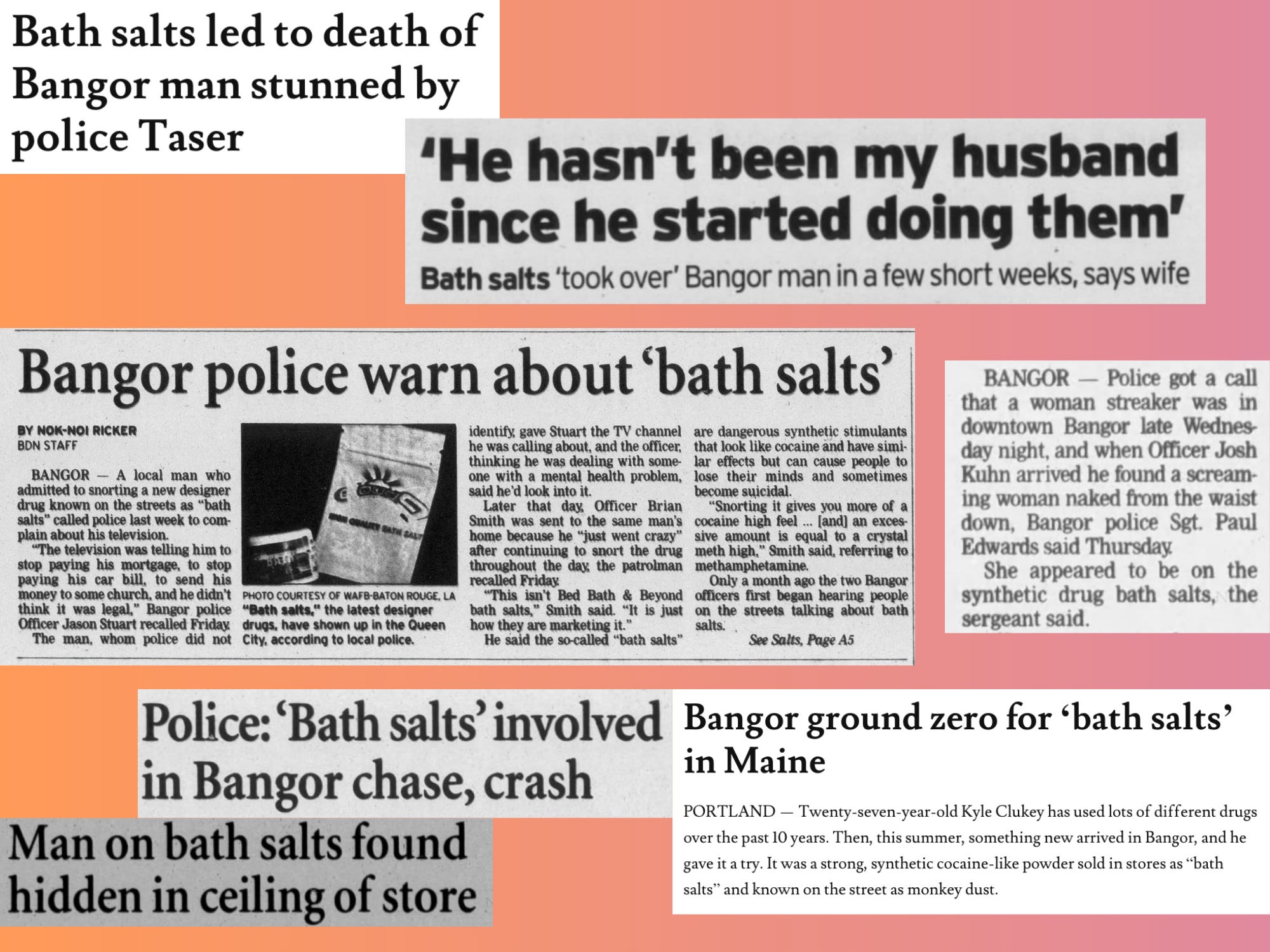
It was one of the first public incidents in what was to become one of the strangest summers Bangor had ever experienced. For most of the rest of the year, Bangor was ground zero for bath salts - not just in Maine, but nationally. Local news ran near-daily stories about unhinged people under the influence of the drugs – threatening people with firearms, experiencing intense, terrifying hallucinations and running naked down the street. Bath salts could, in extreme cases, cause a person’s body temperature to spike as high as 107 degrees, and make a person so agitated their muscles begin to break down and their kidneys begin to fail. In 2011 alone, 152 people in Maine overdosed on bath salts, and at least three died.
The drug known as bath salts is composed of three active ingredients: methylenedioxypyrovalerone; 4-methyl-N-methylcathinone, also known as mephedrone; and 3,4-methylenedioxy-N-methylcathinone, or methylone. Methylone has the same molecular structure as MDMA (i.e. ecstasy or molly) but with the addition of one extra oxygen atom, which dramatically increases its potency. All three chemicals share structural similarities with amphetamines.
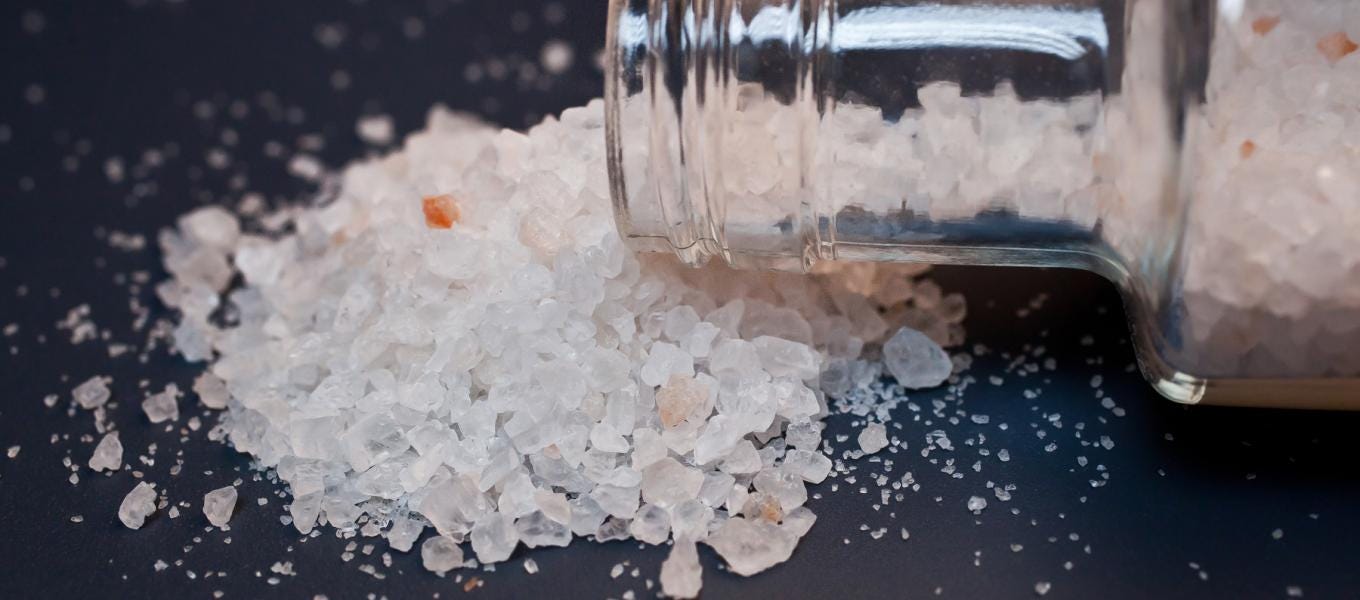
The drugs first reached the U.S. in 2010, and at the time were completely unregulated by either the FDA or the DEA. The chemicals were mostly manufactured in China and India, and were shipped around the world - Britain had a bath salts problem long before the U.S. did. At first, they were available to buy as a powder in individual packets, in gas stations and head shops, under a variety of names. Not long after, homemade blends of the three active ingredients also began to circulate, cut with a wide array of other substances, ranging from lidocaine and anti-depressents to sugar and cornstarch.
Emergency rooms in Bangor began to encounter patients under the influence of bath salts in spring 2011, who had both snorted and injected the drugs. The influx was sudden and unexpected, and caught staff off guard with the severity of the symptoms and behavior of the people coming in.
Dr. Anthony Ng, who arrived in Bangor in 2010 as Acadia Hospital’s new medical director of psychiatric emergency services, said it wasn’t immediately clear what was wrong with them. Traditional sedative drugs didn’t work on them, and many had to be physically restrained.
“At first, I thought perhaps these people were on PCP, which was something I’d encountered when I was in Philadelphia and which can have similar effects,” Ng said. “Pretty quickly, though, we realized we were dealing with something else. The people that found their way to the ER were just incredibly combative. Psychotic. Completely out of control.”
At that time, the drug was in all 50 states, but several states in particular were hit unusually hard. Florida saw bath salts usage skyrocket, as did parts of Appalachia and the Midwest, including western Pennsylvania, West Virginia, Ohio and Indiana.
And, most notably, in Maine, where in 2011 hospitals and police departments statewide saw a dramatic increase in people in serious physical and psychological distress from taking even small amounts of the drug.
“It makes the brain go crazy,” Ng was quoted by the Bangor Daily News in a September 2011 article. “It’s frightening.”
Nowhere in Maine was hit more suddenly and severely by the bath salts epidemic than Bangor. Ron Gastia, who in 2011 was Bangor’s chief of police, said that starting in Spring 2011 and into early 2012, Bangor was, in many ways, the national epicenter of bath salts.
“I got calls from departments in California, in Texas, asking us ‘What the heck do we do?’” said Gastia, now retired from law enforcement. “I think Bangor was actually instrumental in helping the rest of the country learn how to deal with this specific drug, because we had such a huge crisis going on. People looked to us for help, because we were so disproportionately affected.”
That year, Bangor and bath salts became synonymous. The city was the butt of jokes, and the subject of intense, relentless questioning from residents of other parts of the state and New England.
“Is it really that bad?”
“Have you seen somebody freak out?”
“What’s it like living through the zombie apocalypse?”
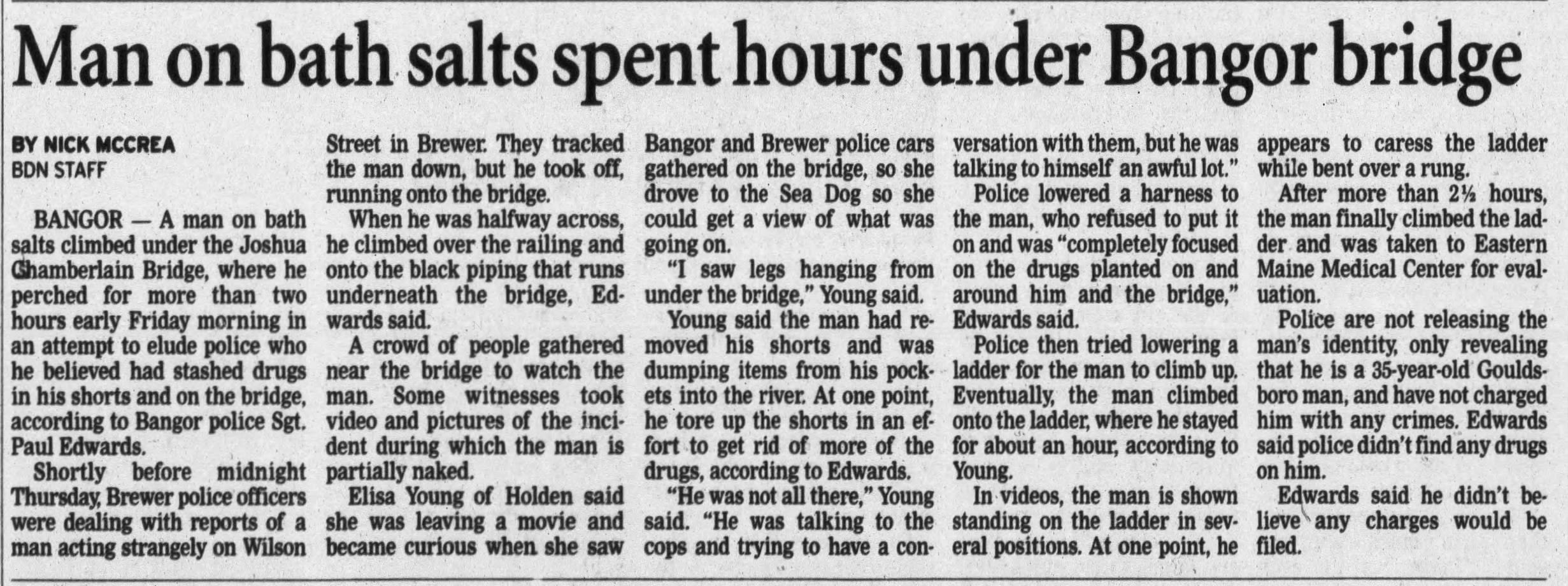
Some stories are well-documented, as evidenced from the news headlines. The guy that smashed through one of the front windows of the Brewer Hannaford with a shopping cart and then crawled into the ceiling. The guy that destroyed the bathroom at the Main Street Circle K in Bangor. The guy that spent hours hanging off the underside of the Joshua Chamberlain Bridge, as rescue boats angled themselves in the river below, hoping to catch him if he jumped or fell. A video of that incident went viral, and now has nearly a million views on YouTube.
Some are more colloquial in nature, though are no less true and upsetting. David Chapman was working at American Retro, a former vintage clothing shop in downtown Bangor, and said someone clearly under the influence burst into the shop one day, brandishing a knife. Chapman escaped unharmed, but the incident terrified him.
Later on that summer, Chapman was sitting at the bar at Paddy Murphy’s - a bartender friend had just closed up on a slow night, and he was hanging out with a few people as the staff finished up - when a man smashed the tail light of a parked car, grabbed the glass from the housing and began cutting his arms open.
“He was actually smearing the blood on the window of the door,” Chapman said. “They’d just closed up and the door was locked, so we were just sitting inside, watching this horrible thing unfold, waiting for the cops to show up. It was completely insane. It really was like the zombie apocalypse that summer.”
So how did Bangor end up being the bath salts capital of America? After 15 years, no one - not even the people most directly involved in coordinating the city’s response to the crisis - has a very good answer to that question.
Former police chief Gastia said that, based on his experience, he doesn’t believe there was an out of state source that was shipping the drug in through established trafficking pipelines. Dr. Ng, from Acadia Hospital, said there was some overlap between bath salts users and distributors and people using and distributing meth in the Bangor area, but that certainly wasn’t a full explanation. In Bangor, most users were purchasing bath salts from local businesses, or from basement chemists cooking up their own versions of the drug.
“I remember seeing it literally next to the cash register at one convenience store,” Gastia recalled. “This totally volatile and dangerous drug, as easy to buy as anything. And incredibly cheap, too. And the thing is, it was available like that in other parts of the country. Why didn’t it happen in Connecticut or New Jersey? Why here? I just genuinely don’t know. It’s all baffling. It’s still baffling to me.”
Between 2010 and 2011, drug-related crimes in Bangor jumped by 35 percent, a statistic Gastia attributes entirely to bath salts. He said he and his officers were too busy combatting the problem at hand to ask “why” types of questions.
“At the time, we were deep in the midst of a public health and public safety emergency. I think we decided that it was much more important to stop it, and to help people, than to spend time on figuring the rest of it out,” he said.
Once law enforcement and medical professionals learned how to more effectively deal with people under the influence of bath salts, Bangor-area public health providers mounted an educational campaign to warn about the dangers of the drug, with reading materials and videos distributed throughout the region that fall, and community forums held.
Though the Maine Legislature had banned the drugs in July 2011, in October of that year, the federal government banned the three main chemical components of bath salts. By 2012, the availability of the drugs in not just Bangor but nationwide had plummeted, and multiple trafficking arrests had been made, cutting off supply even further. The flood of unhinged emergency room patients had been reduced to a trickle. In July 2012, President Obama signed a bill banning a wide array of synthetic drugs, including bath salts and synthetic marijuana.
Less than a year after it started, the bath salts crisis in Bangor was, for the most part, over. Isolated incidents continued to pop up over the next few years, and trafficking arrests continued into 2014 and 2015, but the overwhelming influx of 2011 had ended. Today, few people other than those that actually lived in Bangor at the time remember it even happened - though those that do remember have it permanently seared into their memories.
Despite the bans, synthetic drugs are still out there. It’s relatively easy for home chemists to change one molecule in a banned substance and make a new drug formula that escapes the ban. And ban-skirting drugs are still widely available in gas stations nationwide - from sketchy pills that claim to give men a massive erection, to addictive substances like kratom and tianeptine, both of which are presently 100 percent legal and available to purchase in stores in Maine.
In Bangor, the bath salts crisis presaged other issues currently facing the city, like the twin public health crises of homelessness and substance use disorder. Looking back on the crisis, Dr. Ng, who now leads community services at Acadia Hospital, said that he believed it helped organizations and service providers Bangor learn about the value of collaboration - and that there’s a lot that can be learned from it for people struggling to combat the crises of today.
“In a public health crisis - which is what this was - you can’t have people on their own islands. You have to communicate with each other, and collaborate with each other. And you have to have follow-through on every step of the process. Otherwise, you won’t actually solve the problem,” Ng said. “I think how we responded to the bath salts crisis and the urgency with which we had to respond are useful when we think about how we deal with homelessness, or the opioid crisis. The community has to see it as an urgent priority, and you have to get buy-in from everyone that can help. It’s hard, and it’s complicated. But it can be done.”
Great journalism, Emily, with your familiar touch of a personal perspective (and Bangor's). At the same time that you don't shirk on the bigger perspective. As I said, great journalism.