
Planet Bill
Fiction: What's he building in there?
I didn’t know Bill Bishop at all. I’d never had a conversation with him. I’d known his nephew, Aaron, for a while, but it was years before I found out he was related to Bill - the man with the long hair and massive gray handlebar mustache, who rode a neon-colored electric bike towing a little trailer around town and sold Christmas ornaments made from broken toys and painted scrap metal at area boutiques.
Bill was hard to miss. He was a local weirdo; an artist who lived in what looked like a crazy hoarder house on the west side of town. Every town’s got one, especially in Maine. The kind of guy recognizable from 100 feet away, who scared normies and the elderly just by existing. You’d see him at the post office, at the thrift shops and grocery stores, sometimes pedaling around art festivals or parades. He didn’t really talk to anyone; just waved and smiled beneath that Wilford Brimley mustache.
People assumed lots of things about him. I’d heard, variously, that Bill was schizophrenic, that he didn’t have indoor plumbing and shit in a bucket, and that he took so much acid in his youth that his brain was permanently shattered. A friend of mine said he thought he was an interdimensional being. Much of it was plausible, but I suspected none of it was true. Except maybe the acid thing. Or, for that matter, the interdimensional thing.
A Bill Bishop ornament with the plastic head of Jar Jar Binks and He-Man arms attached to a green and red bedazzled metal body hung on our Christmas tree for the past few years. I liked my alien pop culture monstrosity. I liked what it said about me. It said I was the kind of person that didn’t take the holidays too seriously, and more importantly: that I was a person who appreciated a weirdo.
Aaron, the nephew, was smoking a cigarette one evening outside the bar where he worked, and we struck up a conversation. He casually mentioned his Uncle Bill - you know, the one with the crazy mustache? The guy that does the toy stuff? That guy? Yeah, that’s my uncle. I told Aaron I’d always wanted to meet him and try to write something about him, but whenever I saw him on the street it never felt like the right time to approach him. He gave me Bill’s number. He said he didn’t have a voicemail, so if he didn’t pick up just call again later. Eventually, he’d answer.
I called him a week or two later. Bill picked up on the first try. I told him I knew his nephew Aaron. I said I wanted to come see where he made his art and see if we couldn’t tell his story somehow, in a magazine or newspaper or something somewhere. Bill said to come over on Wednesday afternoon. Why not, he said. I’ve never been in the paper before.
I pulled up to Bill’s house on Spring Street, tucked back from the road behind a front yard that hadn’t seen a mower in a while. A massive pine tree stood on one side of the lawn; shaggy, inky green and incongruous among the leafy maples. A metal spider with hot pink legs and a robot head stood on the other side, dandelions poking through its hollow thorax.
I raised my hand to knock on the door, but it swung open before I made contact. Bill held a Star Wars blaster, pointed at me, a big grin on his face. It startled me, though I tried not to show it.
“Halt! Who goes there?” he said. “Oh, it’s you! The writer! My apologies. You can’t be too careful these days. Welcome! Come on in!”
I stepped into the hallway. To the left, a staircase, with what looked like a xylophone or marimba bolted to the wall. To the right, probably 30 or 40 hubcaps, each adorned with a hundred plastic bits and pieces arranged like a mandala. Plastic tubs and cardboard boxes jammed with papers and deconstructed objects were stacked high in every corner. I told Bill that it was a lot to take in, in the hallway alone.
“Oh, that’s just the beginning. This is my little playland. I call it Planet Bill. It’s where I do my art. It’s my kingdom, and I’m king. I’m a nice king, though. I’m Good King Bill. We have a nice relationship, me and my subjects.”
He pulled a black plastic trash bag out from a Rubbermaid tub and held it open. I peered inside and saw a thousand things - Barbie shoes and handbags, Teenage Mutant Ninja Turtles nunchucks and swords, tiny vegetables and kitchen gadgets and Hot Wheels and circus animals and Powerpuff Girls and on and on.
“I’ve got a million of these. I’m always finding new stuff. Or maybe it finds me.”
We moved out of the hallway and into what appeared to be the living room, though the only evidence of living was a battered loveseat, an ancient, massive TV, and a big box of VHS tapes and DVDs. More Rubbermaid containers were shoved into the corners. A rough metal chandelier shaped a bit like a flying saucer hung precariously from the ceiling; an early welding effort, Bill said, something he’s much better at now. Wooden boards on the walls featured elaborate, intricate scenes, like Commander Data lecturing to a panel of Smurfs, or tiny, iridescent fairies dancing around a bonfire while Yogi Bear hid behind a tree, watching.
I told him his art made me laugh, in a good way. Was that intentional?
“Oh, yes. It’s funny to think of all these people together. I wonder what they’re saying, you know? What kind of conversation is Data having with Papa Smurf? I bet it’s pretty interesting.”
Bill started making his art decades ago, he said; he was called to it, essentially. He grew up in a deeply religious family and spent a lot of time playing with toys on his own, away from his strict parents. His older brother bullied him for it, especially when he kept doing it into his teenage years. He didn’t have a lot of friends. Toys were his friends. As soon as he got his own apartment he began messing around with metal and plastic and other things he could find at the dump or the Salvation Army or yard sales. He bought the house on Spring Street 30-something years ago. He taught himself to weld and forge and wire and paint. He was a janitor at the nearby middle school for decades. He never married. It’s just him and his 10,000 friends, living in harmony on Planet Bill.
“I’m a hermit, really. I like people, but I’m happier at home. This is all for me. Not a lot of people ever come in here. I’m very protective of my space. But you’re special.”
Why was I special? I was taken aback. Bill fiddled with his mustache, something he did constantly. He was a big guy. Tall and solid, but utterly unintimidating as soon as he started talking. Guileless, in a way. He talked in a lilting kind of cadence; it reminded me of someone at a Renaissance Faire, or an amateur Shakespeare production. He didn’t seem real; more like a movie character - the guy the heroes track down so he can forge them a new weapon, or bring someone back to life using ancient magic.
We went through more of the house; the attached garage where Bill did his welding and “messy” work; an office of sorts where he ordered things off eBay, and a kitchen that hadn’t been updated since the 1970s, at least. A child-sized doll wearing a suit of armor stood in the corner by the fridge. Bill said he spent months welding and hammering each individual piece of metal for the armor. They ate breakfast together every morning.
I asked him if he ever thought his art was observing him, or if he thought all his toys and sculptures ever came alive, a la “Toy Story.”
Bill looked at me curiously. A tinge of sadness, I thought, crossed his face, though it was hard to tell. He was a walrus mustache, with two shiny, watery blue eyes and a narrow nose atop it, all attached to a large body covered in black watch plaid.
“No. They’re toys. They’re inanimate objects. I know that. I’m not crazy. I don’t actually think that.”
He gestured toward the screen door in the kitchen and told me he’d saved the best for last. We stepped outside, and down some slightly terrifying steps into the backyard.
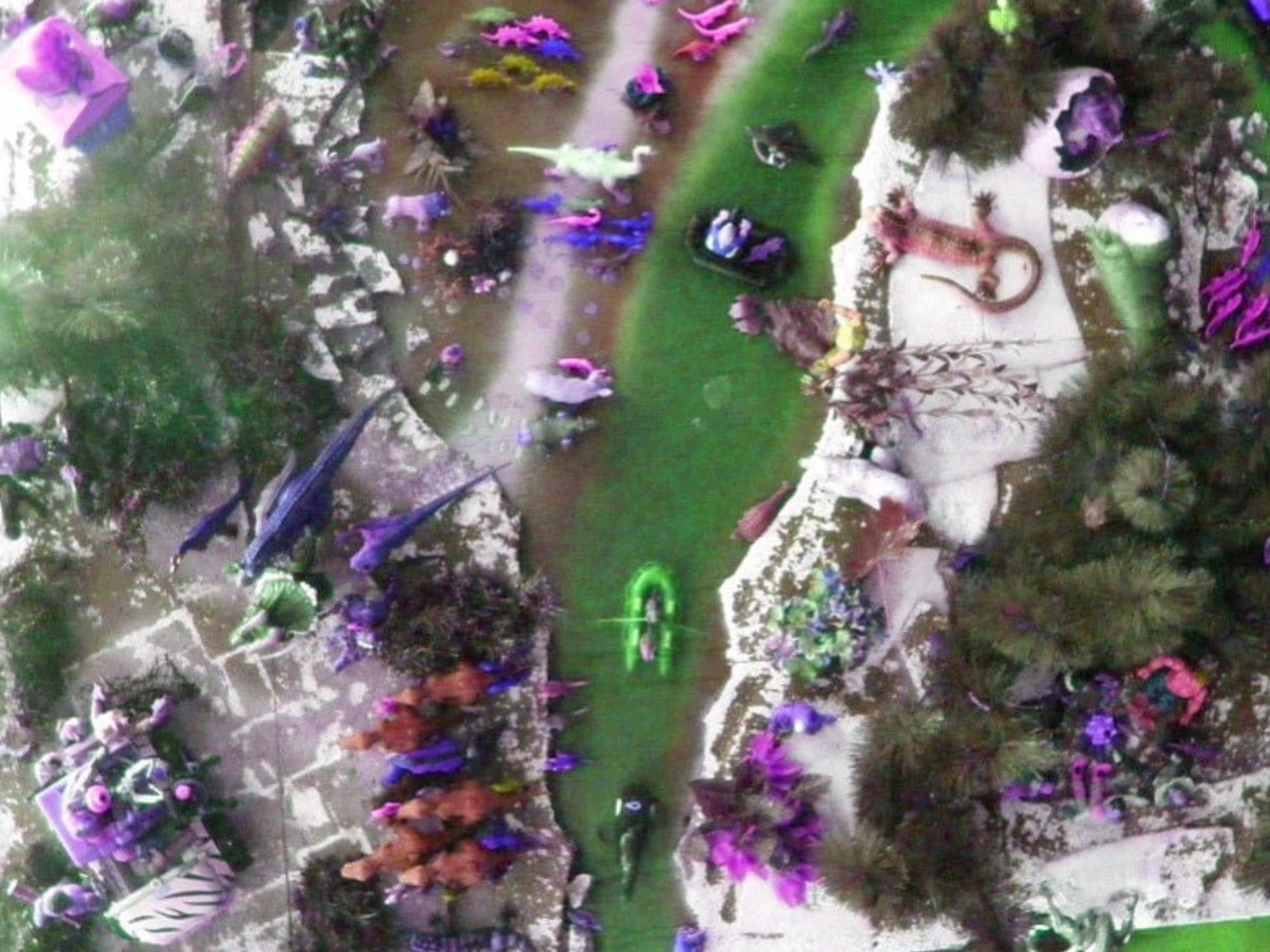
All around us, huge wood and metal panels were rammed into the ground, each at least 12 feet tall and covered in things; every inch of them, traced with little roads and signs and spindly wire trees, cities and fields and rivers and towns, populated by characters from what seemed like every cartoon or toy franchise from the past five decades, all talking and fighting and farming and eating and living. The remnants of the morning’s rain showers glistened in hat brims and train cars and the eaves of buildings. It was monumental, and unearthly, somehow. I snapped a photo of Bill, standing like a druid in the center of his megalithic monument.
I thought about Stonehenge. I thought about the statue of Ozymandius, in that poem; half-buried in the sand, awful and elegiac and somehow both dead and alive. I thought about discovering some alien spacecraft, hidden in plain sight. I thought that was a completely ridiculous thing to think, except that that’s what I thought about, and how I felt. For something made out of old, discarded toys - things played with and chewed on and broken by generations of children - the effect was impressive, thoughtful, intricate, made with craftsmanship and vision. Bill said he’d worked on it for nearly 30 years. He built it to last, through torrential rain and heavy snow and wind. It would never fall, he said. He’d made sure of it.
I asked him if he ever invited people over to see his work. It seemed a shame to keep it stored away.
“Not really, no. I mean, a few people. My cousin Jenny. My nephew, your friend Aaron. He’s not really my nephew, you know. He’s Jenny’s kid, so whatever that makes him. Oh, and my neighbors, of course, although that’s a whole other story. The lady who sells my ornaments. And you.” He smiled; a little sheepish, a little nervous, partly obscured beneath the heft of his mustache.
I thought to ask him if he ever got lonely, and then thought the better of it. He had 10,000 friends, who may or may not be inanimate. And I didn’t want to make him feel bad, this strange giant of a man. He seemed fragile, in a way; like he could shatter under the wrong circumstances. There were things he didn’t want to talk about, or couldn’t. He was more of a mystery than I’d previously thought.
We stood in the yard, among the towering pillars, each leading to different possibilities, different realities, molded from plastic and shaped by fire. We didn’t say anything for a minute. Bill broke the silence.
“Well, I hope you’ve enjoyed my little art projects. You’re probably bored by now.” I got the picture.
He walked me back through the house to the front door. I told him I was moved by his art, and if he ever wanted help with finding a place to display it outside of his house, I’d be happy to provide in whatever way I could.
“You just write your story. Don’t get me in trouble. Don’t make me seem too weird. Even though I probably am weird.”
I wrote the article, and it was published in a local magazine a couple months later. I never heard from Bill. I called him a few times, hoping to find out if he read it, if he liked it, if I could convince him to show more people the landscapes and cultures of Planet Bill. He didn’t pick up.
A few years went by. I saw Bill ride his bike through town each summer, and waved each time; he waved back, and continued on his way. Was he avoiding me? Did I upset him? I didn’t want to chase him down. I drove past his house periodically. I couldn’t see the pillars, but I knew they were there, hiding behind a rickety fence and thick, bushy maples. The hot pink robot spider still stood guard in his front yard, but the grass grew higher and higher through its legs, almost completely obscuring it by the end of the summer.
Aaron stood outside the bar one night, as he did most nights, smoking a cigarette. I said hi as I walked to my car, and he stopped me to tell me his uncle Bill was dead. He had cancer, apparently, but didn’t do anything about it. He dropped dead a few weeks ago. No service, no obituary. Too expensive. Aaron and his mom were the only family that cared to do anything about anything. Big yard sale at his house next week. 9 a.m. Saturday. If I wanted to come by I could pick through it all. There’s a lot of shit there, Aaron said. A lot of it would probably just go to the dump.
Saturday morning, I pulled up along Spring Street. There weren’t that many cars there. Inside, I said hi to Aaron, met his mom Jenny, and noticed that someone had already claimed the robot spider out front, and the xylophone or marimba or whatever it was that hung in the front hallway, and the armored doll in the kitchen. I asked if I could go see the pillars.
I swung open the screen door and stepped outside, Aaron following behind me; the pillars were still there, of course, as firmly planted in the ground as they were when I first saw them nearly five years ago. Roads and rivers still criss-crossed its landscapes, and communities populated by Gumby and Polly Pocket and dinosaurs and glow-in-the-dark little aliens were still thriving, even if their colors were more faded by the sun. It was as impressive as I’d remembered it.
Aaron said that they’d tried to get them out, but after digging down four or five feet they realized Bill had somehow rooted the pillars even deeper, with concrete poured in to further secure them. They didn’t know how he’d done it, they said. Never saw a backhoe there or anything. They were afraid there were pipes down there. They didn’t want to call the city. They didn’t want to tell the neighbors. It was fucked, Aaron said. They had no idea what they were going to do. They might just have to rip it all up, so they could sell the damned house.
I traced my hand along one of the pillars. I felt bad for Aaron and Jenny. It was an impossible situation. Planet Bill was an immoveable object. I managed to snag a couple of hubcap mandalas for $20 each. I hung them in the hallway, like Bill had. If I’d had the money, I’d have bought the whole house myself and preserved it somehow. Bill never got the recognition he deserved - not that he particularly seemed to want it. Maybe it was better that way.
I continued to drive by Spring Street now and again, just to check on the house. It became more and more decrepit each year, with broken windows and a sagging roof. A yellow condemnation notice appeared on its door. I hadn’t seen Aaron in years; he’d gotten a new job, and wasn’t at the bar anymore. The pillars remained in the back yard, towering among the spring wildflowers and winter snow, their foundations deep and mysterious and untouched. I couldn’t see them over the fence and the trees, but I knew they were there. I could feel their presence.
I thought to check the tax maps, to see if the family still owned it. I was surprised to see that someone had purchased it a while back - or rather, an entity, the Bill Bishop Trust, run by 27 Spring St LLC, with an address at an industrial park on the outskirts of town. I tracked down Aaron and he said yeah, someone bought it. He never met them. It was all done through emails and a lawyer. He was just happy to get a check and put it all behind him. Why did I want to know, he asked. I said I was just curious. I was obsessed.
I drove out to the industrial park. The office was tiny, and empty. The landlord said he didn’t know anything about his tenants, only that they paid their rent and caused no issues. If I’d had the money, I’d have hired a private investigator. There weren’t many days that went by when I didn’t think about Bill.
One night, after a few glasses of wine, I went over to Spring Street to have a look for myself. I didn’t tell anybody - I rarely discussed Bill Bishop. I thought it would make me sound insane, going on about this weird dead guy with this fantastic, unearthly monument in his backyard. I didn’t want to be a conspiracy theory person, even if I was one, in a way. I knew something strange was going on. When I thought about it, the backs of my knees tingled. It felt like I was reaching my hand through a wall that was previously solid, now liquid.
The front door was unlocked, so I felt justified breaking in. The whole interior was empty, except for trash left by squatters, and the fridge and stove that were already old when I first visited nearly ten years ago. The frenzy of color and plastic and metal, at once chaotic and orderly, was long gone. I opened the screen door, nervous and excited to lay my eyes upon the ruins of a once mighty civilization; to step off the spaceship and set foot upon Planet Bill.
I blinked, my mouth partly open. It was all gone. The ground was flat; no pillars, no toy society, no strange genius to oversee it all. No evidence of any digging or uproot. No towering monument to something - another country? Another world? Another universe? The connection was severed. I stared for a while, knees tingling, trying to register what I was seeing.
I shined my flashlight across the yard, and slowly stepped into the middle of where the circle of pillars used to stand. It was a half moon night in late May, but the air was chilly, and the trees shuddered and bent in the wind, hissing like an old steam radiator.
I grabbed my phone, to look at the photos I’d snapped over the years of the pillars, and of Bill; a handful of images I’d pored over hundreds of times. I scrolled through to find the folder I’d stored them in, but I couldn’t find it. It had disappeared from my phone. Was it still on my laptop at home? I didn’t want to look.
I knelt down, for some reason, to examine the ground. I put my ear to it, as if I’d hear something. I ran my hand over the grass. To my eye, some of it seemed faintly discolored, roughly in the shape of where the circle was. Hard to tell, with only a flashlight and half the moon. Maybe it was the wine.
I noticed something in the grass, and plucked it off the ground. It was one of those little plastic aliens that had populated Planet Bill, faintly glowing in the dark. I looked up at the sky, half-expecting to see something up there, but it was all empty black nothingness. The trees hissed. My hand glowed, a little. I laid down flat, and closed my hand over the toy, and asked it to take me away, too.


