

The big rock by the lake was the sacred nexus of an ancient trading network
Kineo is the coolest mountain in Maine.

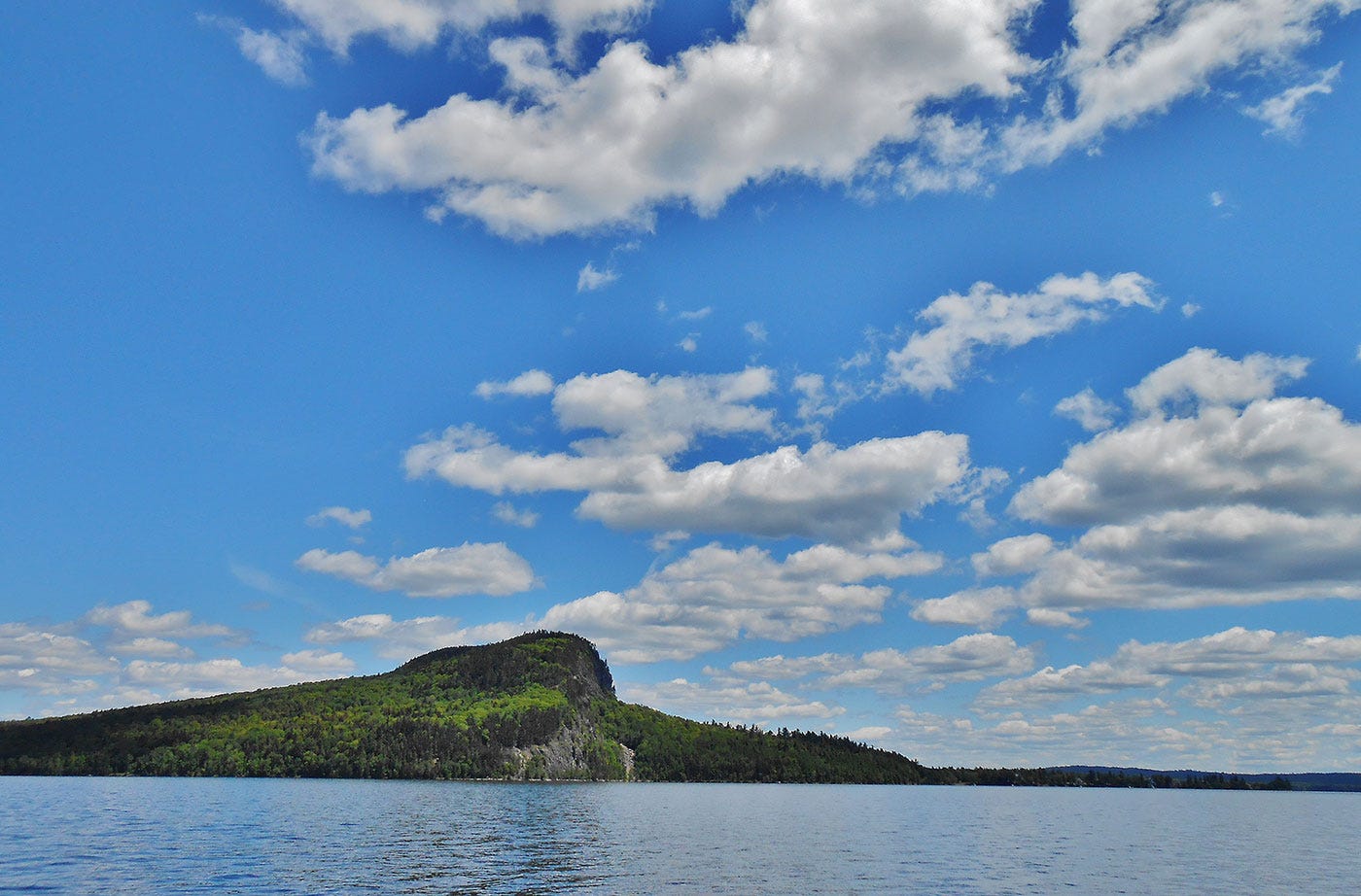
One of the most purely enjoyable hiking experiences I’ve ever had was about ten-odd years ago, when we loaded into the souped-up pontoon ferry boat at the Rockwood public landing and crossed a portion of Moosehead Lake to land at Kineo - the great volcanic monolith that towers 800 feet over the water, jutting out of the landscape like an evergreen Sphinx.
You can only get there by boat, though the mountain and the land it sits on is not technically an island. Despite Kineo being a state park, the narrow strip of land that connects it to the mainland is privately owned, so even though you could theoretically drive there, you’d be trespassing while doing it. But no matter, because the boat ride - either the public ferry, or via canoe, kayak or a friend with a boat - is a zippy, choppy adventure on its own.
It’s not nearly as tall or as strenuous a climb as other famous monoliths - El Capitan in Yosemite springs to mind, of course, as does Devil’s Tower in Wyoming - but to my extremely biased mind, it’s just as beautiful. That’s not what gets me really excited about it, though: it’s the fact that for centuries, Kineo was not only a sacred place for the people that lived nearby, but was also the engine of a vast trading industry that, at its peak, spanned nearly the entire breadth of the east coast of North America.
We were there in late August, when summer begins its slow turn into fall and as all those interesting plants and fungi begin to pop up. It was particularly colorful along the craggy slope up to the summit - which we ended up climbing, since we missed the turn for the easier trail to the summit, and instead went all the way along the shore and up the backside of the cliff. We barely made the last boat back to Rockwood. A two-hour hike turned into three or four. Oops.
I’m glad we messed up, though, because the kaleidoscope of mushrooms and late-season flowers dotting the climb up was well worth traversing the rather soggy trail to get there - deep purple and fluorescent yellow and cartoonishly perfect-looking red-and-white, nestled among the endless hardwood greenery and against the steely backdrop of Moosehead. It was glorious.


At that time, I’d only recently learned that Kineo was far more than just a beautiful place to hike and observe nature. As was so often the case, when I told him we were going to camp at Moosehead and hike Kineo, my naturalist friend Tony Sohns told me to be on the lookout not just for the growing and living things, but for the rock itself - the rhyolite that composes the majority of the mountain itself.
Though sandstone and slate can also be found in the geological makeup of the mountain, it’s the rhyolite that makes Kineo special both geologically and historically. Rhyolite is an igneous rock that can take a number of forms, including obsidian, a.k.a. volcanic glass, and, in the case of Kineo, as a silica-rich rock that is uniquely suited to being shaped into stone tools like arrowheads, scrapers, chisels and hatchets. The rock itself formed millions of years ago, but Kineo, like so many other mountains in Maine, was shaped by the receding glaciers of the last Ice Age, around 14,000 years ago.
Thousands of years ago, the first people that lived in what is now Maine realized the rock at Kineo was particularly good for making a variety of tools. The Penobscot people, who considered Kineo, with its imposing cliff face, a sacred place, have visited it for centuries, both as a spiritual pilgrimage and to collect the incredibly durable and useful rock. The name Kineo derives from the legendary Wabanaki protector and leader, Kinneho, and the lore holds that the mountain was formed when Gluskabe, the ancient Wabanaki culture hero, picked up a rock and slew a cow moose. That moose became the unique Kineo rock that for millennia afterwards would help future hunters provide food for their people.
Over time, those arrowheads and other Kineo rhyolite tools radiated their way out from Wabanaki homelands and into the well-established trading networks that pre-date the arrival of Europeans. While it’s relatively common to find Kineo tools in coastal Maine, archaeologists have also found them throughout New England and Maritime Canada, and even as far south as Georgia. How do they know they came from Kineo? Because Kineo is the largest single deposit of rhyolite in North America, and because its unique mineral properties are unlike any other rhyolite found anywhere else in the world.
As my fellow UMaine alum Milo Rossi, a.k.a. miniminuteman, explained in one of his highly entertaining archaeology and anthropology videos: “[Kineo is] one of the most important geologic features in the East Coast… [and] because the Indigenous people of North America knew this, Mount Kineo became the epicentre of an enormous Paleo-Indigenous trade network.”

 Tiktok failed to load.
Enable 3rd party cookies or use another browser
Kineo wasn’t the only well-known source of rock for tool-making in Maine. Not too much further north in Piscataquis County, another mineral deposit - this one of chert, a fine-grained stone with bands of red and green in it - was found by Wabanaki people along the shores of Munsungan Lake, a remote body of water about 30 miles due north of Katahdin. Like those from Kineo, tools and weapons made from Munsungan chert have been found all over the Northeast - and, in turn, Kineo artifacts have been found at Munsungun.
It’s not shocking, then, that stone from places even farther away, like Ramah chert, a semi-translucent stone found only at Ramah Bay in Labrador, has also been found in abundance in what is now Maine. Long before Europeans began harvesting timber, furs and fish from Maine’s woods and waters and exporting it around the world, Indigenous people were trading their own goods far and wide.
One of my favorite unsolved archaeological mysteries in Maine is that of the Maine penny, also called the Goddard coin - a Norwegian coin dated to around 1070 AD, found at Naskeag Point in the town of Brooklin. If the coin is genuine and had been laying in the mud for centuries, it begs the question: did the Norse people that visited what is now Newfoundland in the 11th century trade that penny with the Indigenous people of the region, who then traded it with other tribes down the coast until it ended up in the hands of Wabanaki people, in what is now Maine? Scholars have debated its origin since it was discovered in 1957, with some saying the coin is a hoax, and others saying it is evidence of far-reaching Indigenous exchange. Ramah chert artifacts, after all, were also found in that same archaeological site.
Kineo, like so many other natural features across what is now Maine, is a place with far deeper significance than surface-level explorations might indicate. You’d think all its unique characteristics - its unusual geology, its deep history, the quality of its hiking and natural beauty - would make it as popular a destination as other inland Maine hikes, like Tumbledown, Borestone or Gulf Hagas. And yet, when we were there, we saw only a handful of other people on a beautiful late summer day - aside from the small groups playing golf at the nine-hole course at the base of the peak. I’m sure it’s a great place to golf, but man, it feels incongruous next to what feels like a sacred mountain.
At the end of the day, however, it’s probably a good thing that places like Kineo aren’t as popular as Acadia or Katahdin. Thousands of years ago, when the first peoples of this land were making goods out of Kineo rhyolite, they probably knew they had something special - something that had to be visited respectfully, and harvested with great care.
It’s easy to look at hikes, summits, landmarks and bodies of water in Maine (or anywhere) as places to conquer, or to check off a list. It is far more rewarding, in my opinion, to experience them as many things at once. As places of great natural beauty, of course, home to complex, fragile ecosystems that must be protected in addition to being cherished. As places that challenge the body and the mind, to climb higher and think deeper. And as sites where history, both geologic and human-scale, can be felt in the very rock beneath your feet.
If you want to read more about archaeology in Maine and throughout northeastern North America, you should definitely check out this incredibly informative book, “The Archaeology Of The Atlantic Northeast,” by Matthew W. Betts and M. Gabriel Hrynick.