


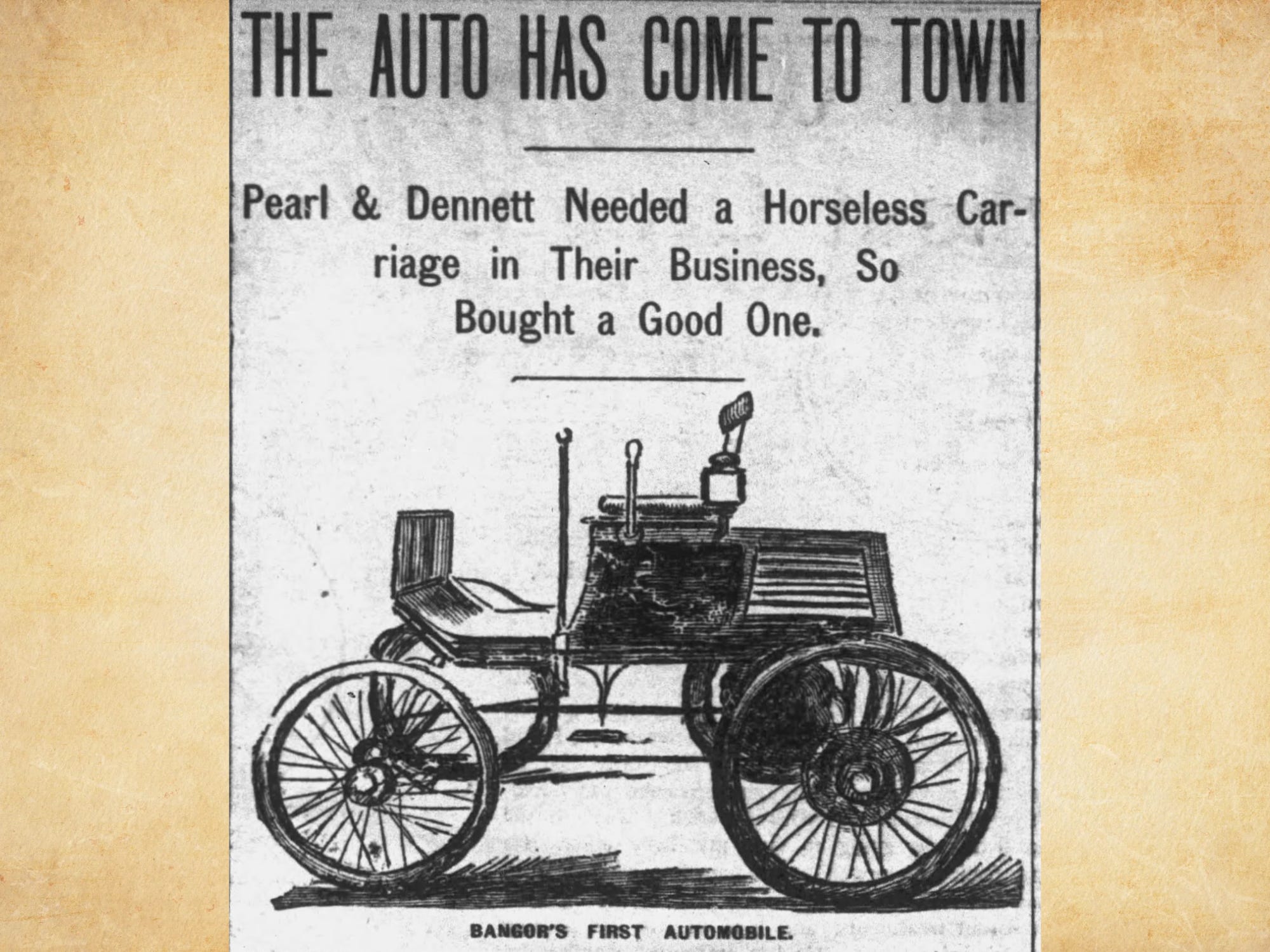
I like to imagine the first time anyone in Maine ever saw an automobile. It was probably sometime in the 1890s, and was likely one of those very early, sputtering old open-top vehicles that only the very wealthy could afford. Probably some Rockefeller or Morgan scion, rattling down a dirt road and showing off the latest technology to the delight of children and consternation of old ladies. Kind of like someone driving a Cybertruck today - a big, obnoxious way to show off how much money (and bad taste) you have, that nevertheless people can’t help but stare at.
A little research, however, turns up a very different story than the one I’m picturing. Decades before the first gasoline-powered car was introduced in 1886 in Germany, a host of Maine inventors and engineers had toyed with the idea of a “horseless carriage.” That’s in keeping with similar ahead-of-their-times inventions all across the world, from the steam-powered vehicles invented in Europe and China in the 17th and 18th centuries, to the primitive electric motors built in the early 19th century.
The first land-powered personal vehicle in Maine was built way back in 1834, by Cyrus Hamlin, nephew of Hannibal Hamlin (Abraham Lincoln’s vice president, lived most of his life in Bangor; you know the deal). I would hesitate to call Cyrus Hamlin’s invention an “automobile,” but it had a steam-powered engine and could carry passengers and move forward in some fashion. The contraption, currently owned by Bowdoin College, was built by Hamlin when he was just 23 years old, and while it’s not exactly a sexy vehicle, it does show some true Yankee ingenuity.
According to the Maine Historical Society, the first car that could reasonably be called an automobile in Maine was actually built in 1858, at a machine shop in Hallowell. Brothers George and Frank McClench and Charles Spaulding built a car powered by a small locomotive engine - it’s unclear if it ran on steam or was powered by some other fuel source, but build it the brothers did. The society says they drove it to Augusta and back to their shop, to be dismantled and not to be run again. Seems anti-climactic, for all that work.
Interestingly, the Stanley Steamer, a steam-powered car invented in Massachusetts and sold between 1902 and 1924, has a museum in the Franklin County town of Kingfield, where the Stanley family originated. There was also the Lombard log hauler, a steam-powered vehicle designed by Waterville native Alvin Lombard in 1901 that hauled logs out of the dense Maine woods much more quickly and efficiently than horses could. The big innovation of the log hauler was that it ran on a continuous track - a precursor to both the military tank and the snowmobile, both of which changed the course of history.
Steam vehicles couldn’t compete with the cheap efficiency of the internal combustion engine, of course, but in hindsight, wouldn’t it have been fun to actually have a steampunk future? We’d all be required to wear top hats and goggles, and our phones would be made of brass and leather. Actually… you know what? Nevermind. Pretend I didn’t say that. That’s too nerdy even for me.
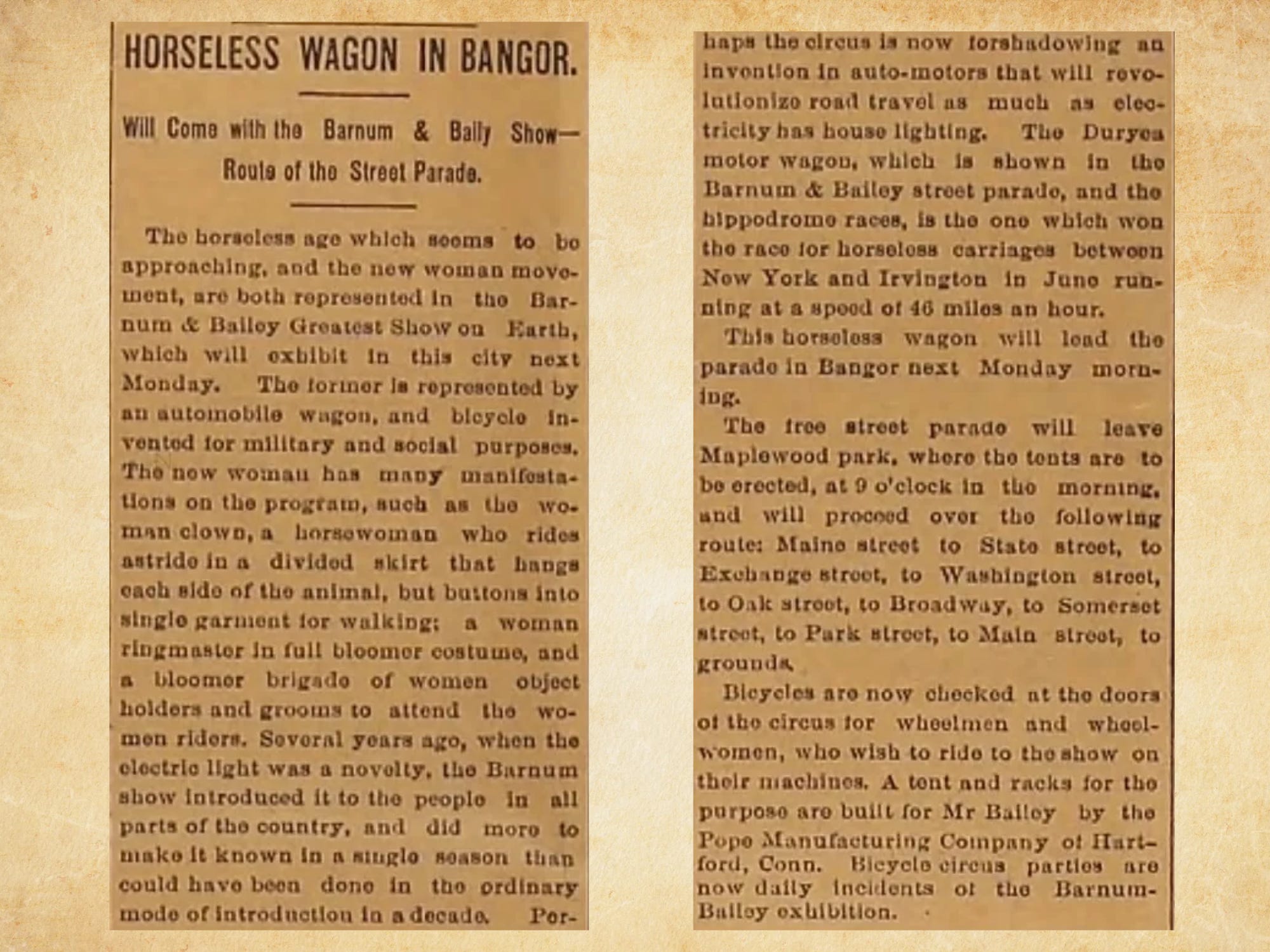
The very first mention of an automobile in the Bangor Daily News occurred on July 31, 1896, as part of an article about Barnum & Bailey’s Circus visiting the Queen City that week, and the accompanying circus parade featuring a “horseless carriage.” The parade would also feature such newfangled concepts as a “bicycle” and the “new woman movement,” which included such gobsmacking developments as a woman performing as a clown and a woman wearing what sounds an awful lot like pants. How scandalous!
By 1900 the first privately-owned cars had started showing up on Bangor’s streets, with the Bangor Daily News reporting that the first-ever locally-owned car in Bangor came to town in May 1900, purchased by the owners of Bangor real estate firm Pearl & Dennett. The press greeted the development with a healthy degree of skepticism, but by the time the Ford Model T was introduced in 1908 it was hard to keep pooh-poohing the entire concept of the automobile.
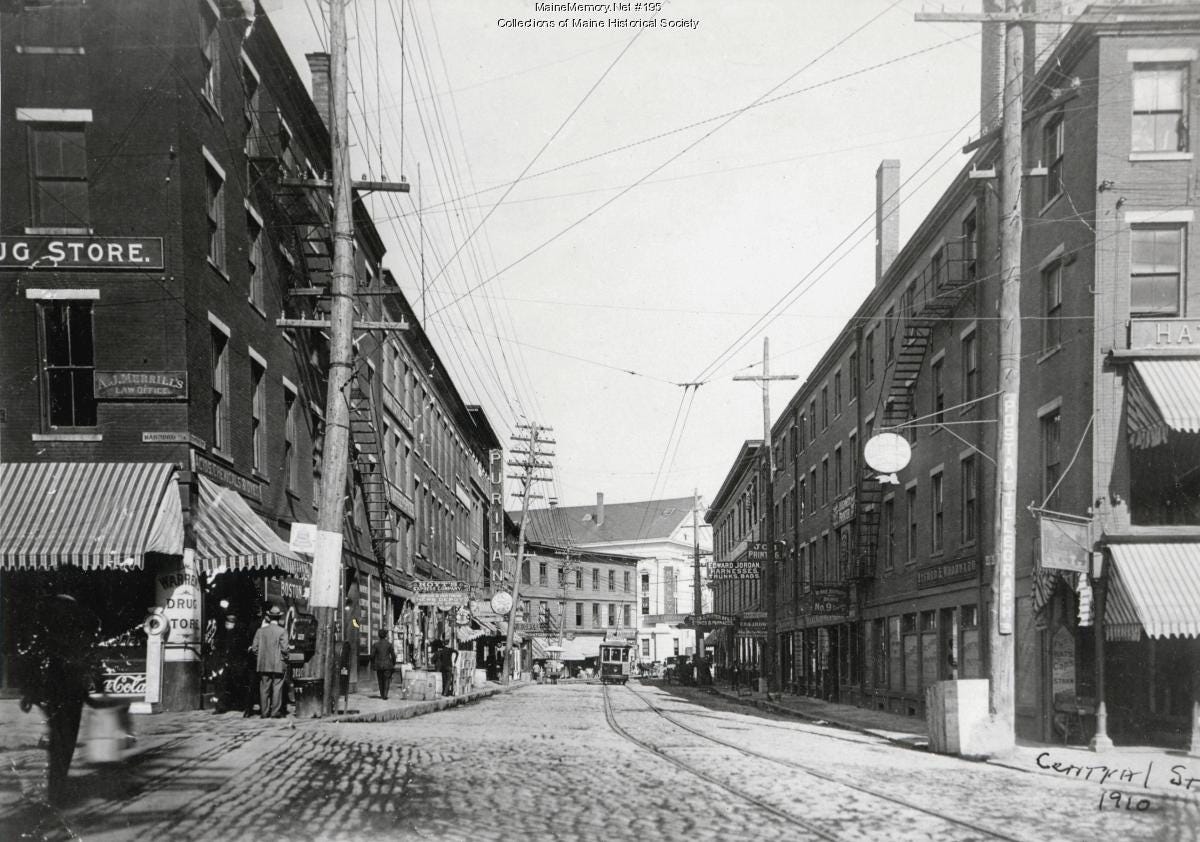
For the first few decades of the 20th century, downtown Bangor was a traffic disaster, as horses, cars, pedestrians and trolleys all fought for street space - and the roads themselves were a narrow, muddy mess of cobblestones, gravel and dirt. Collisions between street cars, automobiles and carriages happened constantly. It wasn’t until 1916 - five years after the Great Bangor Fire of 1911 - that the city adopted any form of traffic control ordinance, or even required drivers to adhere to rules about driving on the right side of the road.
By then it was clear that the era of horses and trolleys was ending, and that the automobile was well on its way to being the dominant form of transportation across Maine and the country. Bangor’s street car system began shrinking in the 1930s and was fully shut down by 1945, and passenger rail - once the pride of the city, with the Bangor and Aroostook Railroad and its grand Union Station - ended for good in 1960. In 1963, Interstate 95 was extended to Bangor, and the following year, Bangor voters approved the urban renewal project, which would reshape much of the city to accommodate for cars over people, buildings and housing.
It’s a far cry from the days when the sight of a horseless carriage (or a woman wearing pants) could cause such ballyhoo. I’d like to think Mainers are still out there in their garages and yards, however, tinkering with old engines and wiring and processors, coming up with innovations that might only run for a day - or might change the course of history.