

The front yard anchor is a symbol of coastal life in Maine
Courtney Naliboff shares the story of her island home's nautical decor

Ed. note: As promised, here’s our first guest post on The Other Maine, from none other than Maine island icon Courtney Naliboff of North Haven. Among her many and varied talents are directing island students in plays and musicals, kicking ass in punk band Bait Bag, writing for many other fine Maine publications, writing a book, swimming in the frigid Maine ocean, being an EMT, and adapting one of the most acclaimed indie rock albums of the 2000s into a children’s ballet. She’s great. - Emily
What is it about anchors?
They pop up everywhere: tattoos, Christian symbolism, nautical-chic scarves and sweaters. They’re aesthetically pleasing, symmetrical and well-balanced, and laden with connotations of steadfastness, strength, and safety.
Actual anchors – massive metal structures hauled up from the seafloor – are also everywhere, at least on North Haven island, where I live. Where some mainland front yards might sport a Virgin Mary on the half shell, a chainsaw-carved bear statue, or the old classic wooden cut-out of a woman bending over, islanders proudly display anchors – if they’ve been lucky enough to find one at the bottom of the ocean.
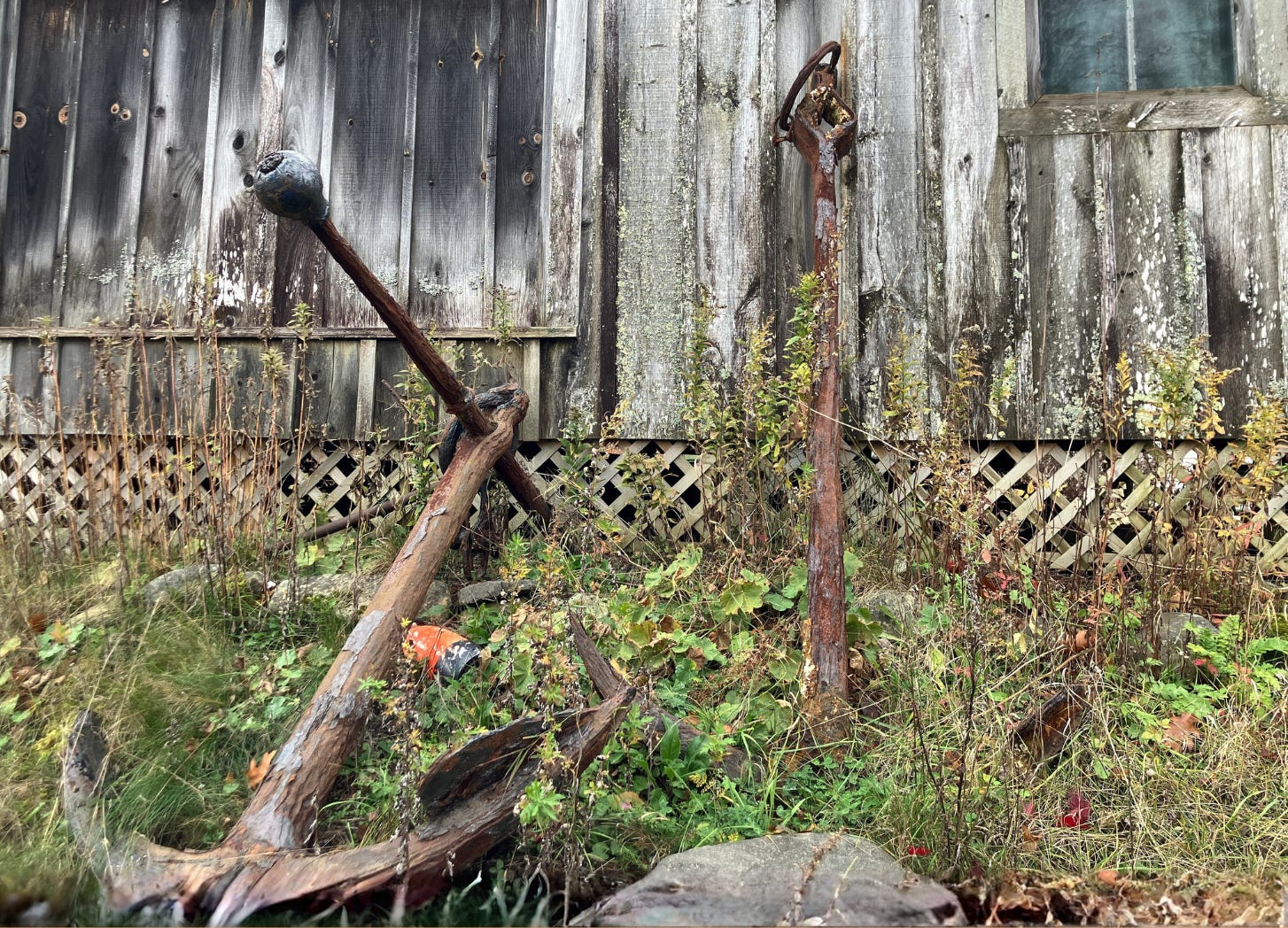
Throughout my two decades on the island, I’ve noticed and admired the anchors, and wondered how they made their way from a boat to a front yard. Four in particular have caught my eye over the years: the two in lobsterman Geoffrey Barrett’s front yard, one in front of Calderwood Hall, and one that used to sit next to the Landing restaurant, and has recently been moved to the North Haven Historical Society.
Geoffrey’s anchors lean against his house, which is between downtown and my house, so I pass it pretty frequently. They’re often joined by inflatable decorations, which rotate for various holidays. My favorite is the Halloween T-Rex.
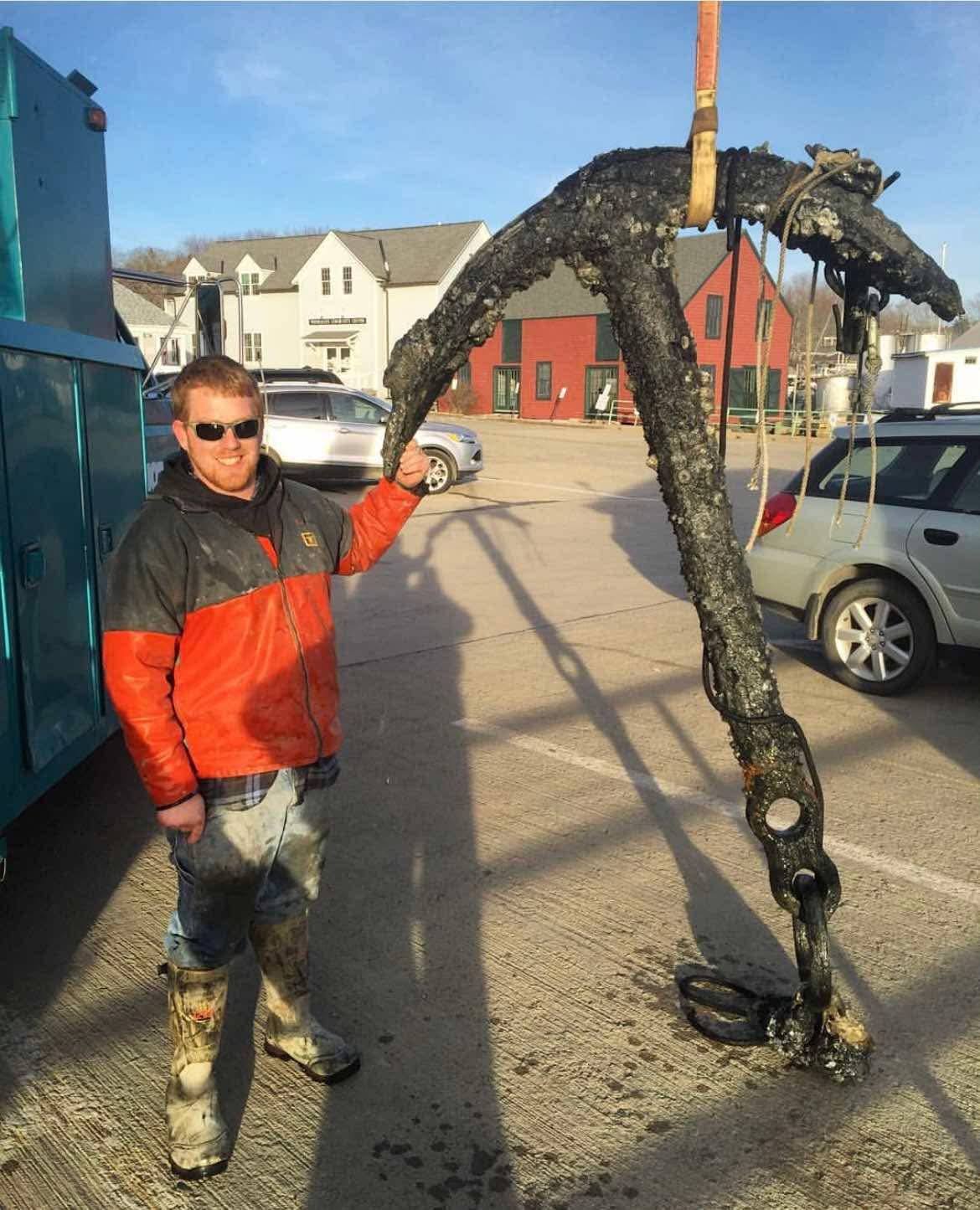
One of the anchors has an intact crosspiece, and is the heavier of the two. Like many salvaged anchors, it was initially discovered because it was a nuisance.
“It ran all the rope out of my trap hauler,” Geoffrey recalled. He abandoned the rope, as he was planning to get a new boat imminently, and returned a few months later to try to haul it up, which turned out to be more challenging than he had initially thought.
“I finally broke it free off the bottom a little. Then I had to do circles, get some slack, and go around it again.” He was able to get the anchor dislodged from the bottom and tow it to a boatyard, where it was hauled out with a boom truck.
His other salvaged anchor comes to a diamond-shaped opening at the top, and lacks the characteristic crosspiece. Geoffrey says this means it was originally made of wood, which subsequently rotted away, and is a tell-tale sign of an older model, perhaps dating to the 1700s. He and a friend initially spotted that anchor while scalloping from a rowboat. Its location, off the island’s oldest wharf, supported its apparent age.
Years later, when Geoffrey had obtained his diving certification, he returned to investigate.
“It was just laying flat on the bottom with a chain wrapped around it,” he said. “It’s not from a shipwreck, I swam all around there and there’s no other treasures.” He tied a rope to it and was able to haul it out with his boat.
For Geoffrey, anchors are themselves a form of treasure. Some fisherfolk are fortunate enough to find one, or even several in their lifetimes, while others never do. This can add a covetable quality to anchors, like a rusty golden apple of discord.
Barney Hallowell, a former teacher and school principal whose diving business, North Haven Salvage, was responsible for locating several anchors in the 1970s, had a few examples. I don’t have permission to share them here fully, alas, but one involved a multi-year silent treatment, while another involved a question of the inheritability of a third of an anchor.
Barney did give me permission to share the story of one of the island’s most visible anchors, which until last year was installed next to the Landing restaurant. Like Geoffrey’s anchor, this one had made itself a nuisance, catching several lobster traps on its flukes. Barney and his fellow diver David Cooper dove on the site to see what was doing the grabbing, and discovered the anchor.
It was hauled up with the boom on a scallop dragger and placed on a concrete pad next to David’s family’s restaurant. Visitors to the island would find the anchor - now sanded down and painted a glossy black - framed in their windshields immediately upon exiting the ferry terminal parking lot. Barney thinks it’s an attractive way to symbolize Maine for visitors and residents alike.
Its invitingly smooth exterior and location next to the restaurant made it irresistibly attractive to 40 years of climbing children - including my own, more recently. When the Landing’s new owners decided to pivot to a seagull as their logo, the anchor was donated to the North Haven Historical Society, where it now welcomes visitors from the front lawn.
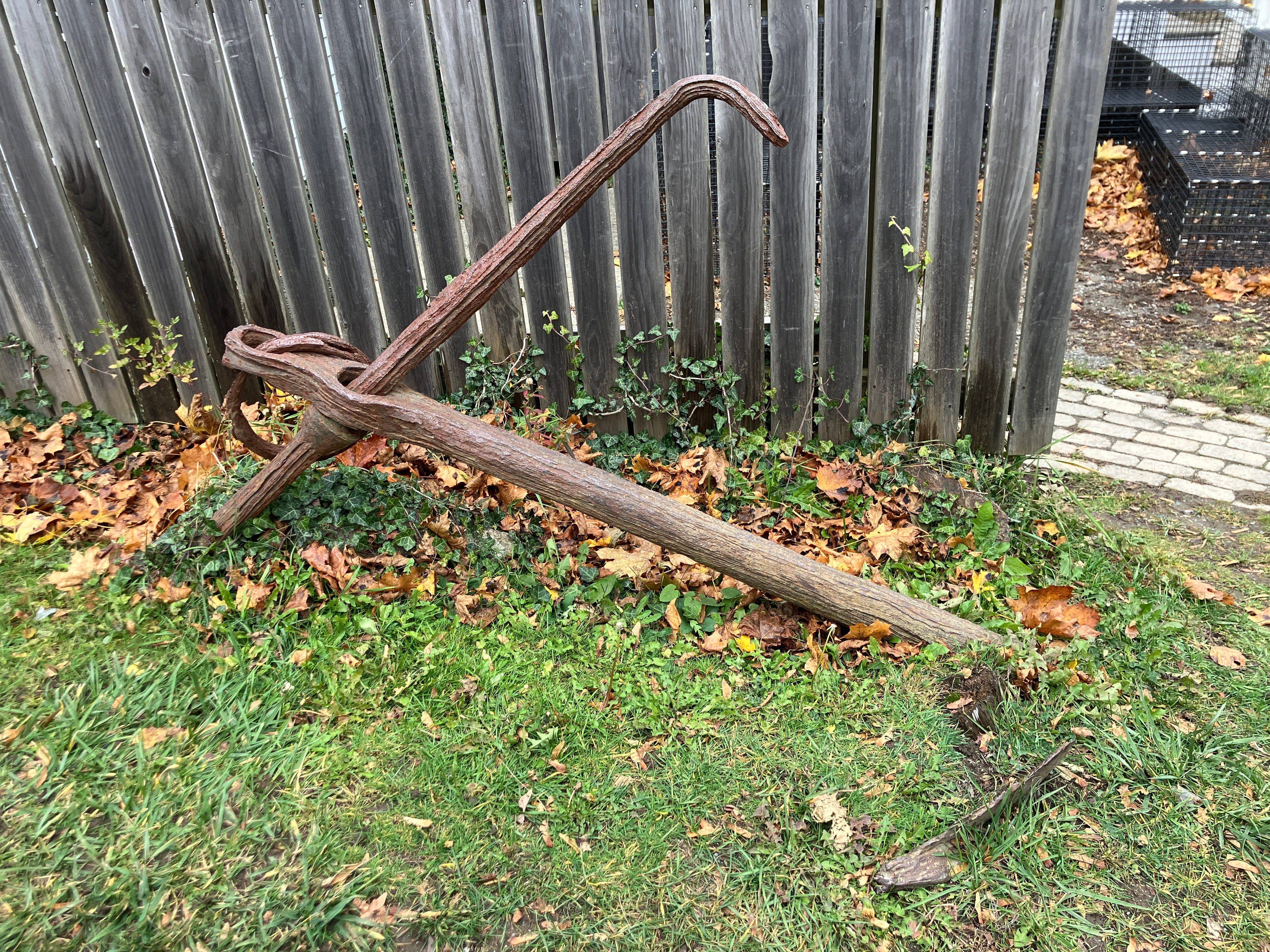
The notion of anchors as symbols of Maine, and perhaps especially of the islands, is reinforced as visitors drive past the Landing and turn left up Smith Street, where an anchor guards the walkway into Calderwood Hall. The multistory building, which has variously been a dance hall, basketball court, gift shop, art studio, and, currently a brewery and restaurant, has had its anchor in place since the late 1970s or early 1980s.
Jon Emerson, whose trap lines had caught on the Landing’s anchor, had a repeat experience fishing off Birch Point. He assumed at first that his lines had been caught on a shelf of underwater ledge, but was unable to release them by circling his boat around.
“Eventually I realized it wasn’t really caught, it was caught on something heavy and if I pulled hard enough it might come towards the boat,” he said.
The calm day allowed him to take the time to slowly pull up whatever it was, and of course, it was an anchor. He was able to bring it alongside the boat and secure it to the side, and eventually hauled it out at the boatyard.
“I didn’t want to bring it home,” Jon said. “It seems like those kinds of things are good to have where they can be seen.” He contacted the then-owner of Calderwood Hall who was excited to have an anchor to display.
The symbolism of anchors isn’t lost on Ben Lovins, who co-founded North Haven Brewery and the Calderwood Hall Restaurant, which now occupy the building’s ground floor.
“There’s this mystery of the deep. It goes into all the things that get swallowed up by the ocean and you can’t find and randomly you stumble across,” he said. Part of the appeal, he thinks, is that the way in which the anchor became separated from the boat is an unsolvable mystery.
The brewery adopted the anchor, wreathed in hops blossoms, as their logo, which was drawn by artist David Wilson.
“People like the anchor, whatever we have the anchor on sells out almost immediately. Part of that is a sense of place, anchored in place,” Ben said.
I have an almost superstitious feeling about anchors - that their presence in yards and in front of businesses helps keep the community here and stops us from drifting away. Trophies or treasures, symbols of strength or apples of discord, each anchor has a story to tell.
 | A guest post by
|