


Note: This is fiction. I never worked in a seafood restaurant. Sure spent a lot of time in them, though.
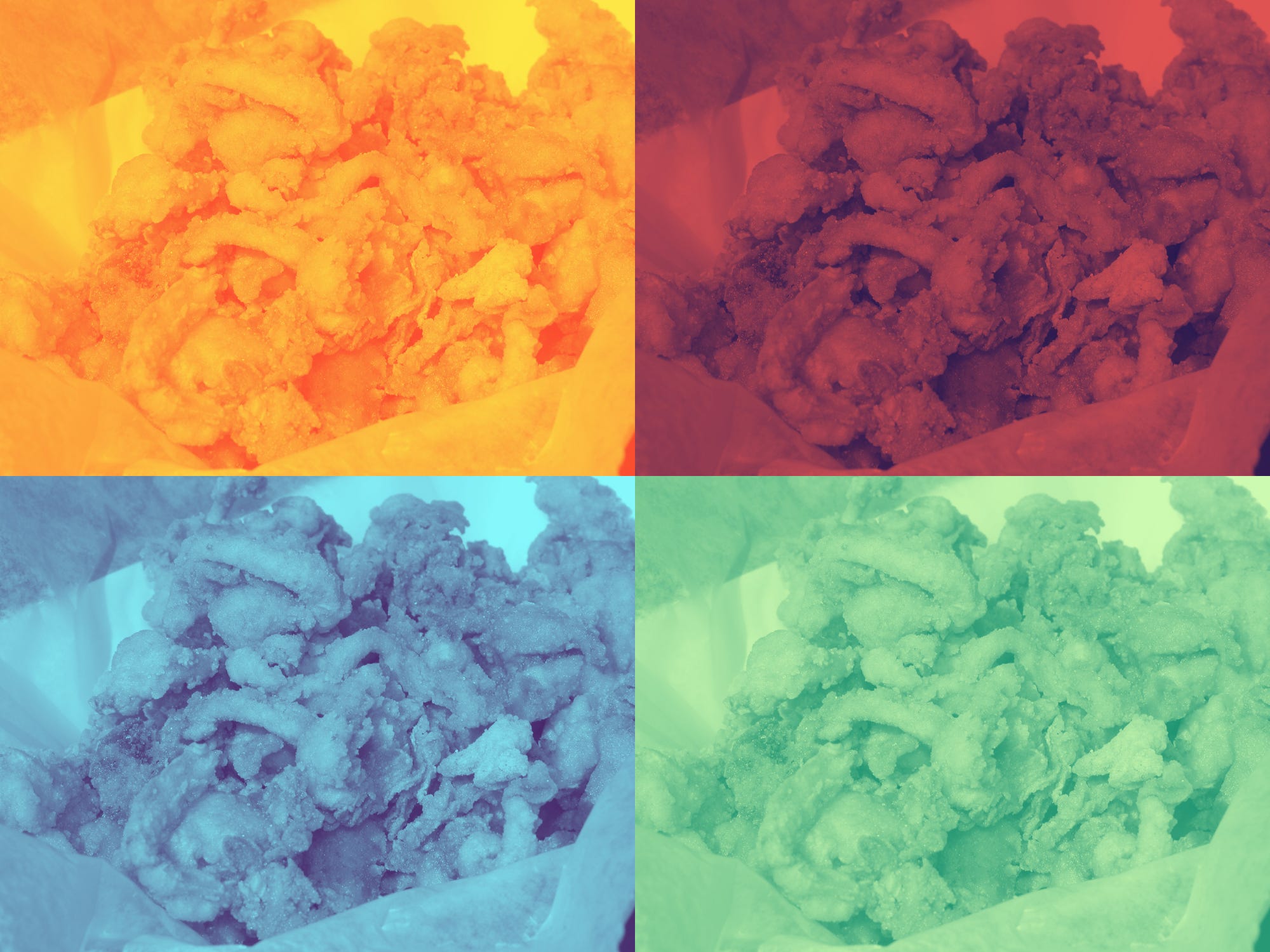
I can smell it now, decades removed from the summer I worked at McCoy’s Oceanside. Thick white slabs of haddock, flecked with gray and shining in the fluorescent overhead lights, dunked in a mix of flour, egg and Budweiser and then bathed in the fryolator. Fried clams, both strips and bellies, never quite fresh or crispy enough for the old timers who always complained, but craved them nonetheless. Little Maine shrimp, too, back when you could still fish for them, fried for just a minute or two until they curled up into submission.
Something happens when seafood meets batter and oil; there’s something at the molecular level that binds to the air and produces an odor that permeates all substances, porous or not. It’s savory and sour, fishy and sulfurous, and a little sweet, like the smell of rotting flesh.
Pair that with the smell of the lobster tanks, briny and bubbling with fresh seawater, ensuring the living conditions are just good enough to keep the prisoners alive. The lobsters lay in brownish-green piles, clattering together in their suits of armor, claws banded to keep them from injuring human fingers or cannibalizing each other, though they still managed to do the latter sometimes. Their eyes - hardly eyes, really, more like black pebbles - see nothing but shadows and light, so the marine scientists say. Do they see the hand as it reaches in to grab one of them and shove them into the steamer box, to be cooked from the outside in? Do they smell themselves? Do they smell us?
There was a third smell, too; cigarettes and laundry detergent and Jim Beam. The smell of Ron, the main cook at McCoy’s. He was the only cook for half the year, for that matter, because once the tourists left in October he was usually the only one in the kitchen. In the summer, he begrudgingly brought in one or two more people to man the fryers and the griddles, and even came to apparently respect Marco, a Guatemalan guy who, like Ron, didn’t care to talk too much. The counter people - generally teenagers like me, 18 years old and freshly graduated from high school – stayed on their side of the swinging kitchen door, only coming in to grab plates or occasionally assist in lobster roll assembly.
Ron was perpetually tan, his skin leathery and deeply grooved, with an ancient tattoo of an anchor on his upper left arm, marked with the date April 14, 1972. He was around 50, about my dad’s age, I think, and had been at McCoy’s for ages. He was hired by the original owner, John McCoy Sr., and when John Jr. took over when his dad dropped dead from a heart attack in 1995, Ron stuck around. He fried the clams. He could break down a cooked lobster in under two minutes. He fixed stuff, whether it was a faulty burner or an electrical circuit that kept blowing. He didn’t suffer fools. He kept the ship afloat.
Ron wore a baseball cap that identified him as a Vietnam veteran, though I never once heard him talk about it, and I’d never have dreamed of asking. When he did talk, it was in short, declarative sentences often laced with a caustic humor, usually after we’d closed up for the night and he was smoking cigarettes and drinking a Diet Pepsi topped off with the Jim Beam he kept squirreled away. He wasn’t an asshole or anything; just gruff and no-nonsense. It was clear from his entire vibe that, for the most part, he’d rather you just leave him alone.
Ron and his tiny crew cranked out fried everything with military efficiency, plated for dine-in or boxed up for takeout, and always next to yellow hillocks of fries. In the cooler, sodas and lemonade and beer, lined up next to tubs of cole slaw and pans of blueberry pie, pre-sliced, ready to be heated up and topped with vanilla ice cream. McCoy’s was not fine dining. It wasn’t even that good, to be honest; it was just fine, and calling it “dining” was a stretch. The seating was entirely picnic tables, both inside the restaurant and outside, broiling on the blacktop beneath the Mike’s Hard Lemonade umbrellas.
We were, technically, oceanside, though ocean-adjacent might be more accurate, since an apartment building and a Central Maine Power transformer separated us from the shore. We claimed we were famous for our “secret recipe” for fried clams, and even had a sign hanging in the window proclaiming it, but you can say lots of things that aren’t exactly true, and about half of the time, you’ll get away with it.
The Mermaid, over by the bridge, was better, so people said, with prices to match. They had a fancy cocktail list and served raw oysters and were famous for their lobster bisque and sunset views, though they did plenty of fried stuff, and had a little takeout window, too. The owner, Frank, a New Jersey guy who moved to Maine a while back, pissed off John Sr. when he first opened the place. John Sr. said Frank came in to eat a few times and then copied all his recipes and stole all his ideas, as if the McCoy family had invented the concept of the lobster roll and the fried clam.
The Mermaid, to its credit, did have a better lobster roll (you could make a case for our clams, though). It also had cleaner bathrooms, nicer staff and was generally much busier – especially in the summer, when the tourists rolled in. You saw a lot of New York plates in the Mermaid parking lot. You rarely saw them at McCoy’s. No one dared tell John Jr. that he could maybe learn a thing or two from them - a little sprucing up, perhaps, try a new menu item or two. Nope. The Mermaid could have their Coquilles Saint-Jacques and cosmopolitans and live jazz on Thursdays. McCoy’s was for the regular people. It had been there for a million years, it was open year-round, and you pretty much never had to wait for anything because there was almost never a line. Ron said McCoy’s was a barnacle on the town’s ass, and it would take a lot more than some fancy competition to get rid of it.
McCoy’s seafood was fresh, that was for sure. Ron cut up the fish himself. The clams came in every day or two from local diggers. And the lobsters - scuttling their segmented legs across the bright blue floor of their bubbling tank - were very much alive. Until they very much weren’t.
I started working there a few months before graduation, to get the hang of the place before the tourists arrived. My Dad knew John Jr., and he knew Ron too, apparently, since Ron identified me as Albert’s kid on day one and that didn’t seem to be a problem. I was a quick learner, and was nice to people, and moved with some level of speed. About a month in he said that I actually seemed to have common sense, unlike most of the kids they got in during the summer. I said it takes one to know one. He smiled, and went back into his kitchen. If an 18 year old and a grizzled fry cook in his 50s can have a rapport, I guess we had one.
By mid-July, we were as busy as we’d ever be, which was only sort of busy. John Jr didn’t come in often, but when he did he usually held a tete a tete with Ron on the landing out back during the slower mid-afternoon hours. I was slicing up a blueberry pie when I overheard him saying that it was the worst summer the restaurant had had in years. Compelled to be nosy, I slipped into the darkened little pantry area next to the back doors, where I could see Ron through a crack, nodding silently as he took a drag on his Marlboro Light.
John Jr went on about gas prices, about food prices, about people expecting too much and not wanting to pay for it. He felt bad, he said. He understood it was hard, but man, he had a business to run. He didn’t want to have to let go of Marco or me or anybody. Ron continued to nod in agreement. He flicked his cigarette into a puddle, took a look at John and said that this town wasn’t big enough for the both of us. John grimaced. He knew, he said. What are we going to do? They’re killing us.
Ron turned around toward the doors and I scurried back into the kitchen to my blueberry pie. I didn’t ask any questions. I was off to college soon, and I wanted to leave town with a little bit of money in my pocket.
The summer carried on. Squadrons of old timers parked themselves at tables and nibbled on clams, and then brought out the cribbage boards. Small children stared into the lobster tank, fascinated by the strange, slightly scary-looking creatures before them; sometimes I’d even pull one out of the water and “hypnotize” it by stroking it from head to tail for a few minutes until it went to sleep, sort of. You could make it sit up on its tail, like it was at the dinner table. You weren’t going to get that kind of a show at the Mermaid.
One shift I burned my arm on the griddle grabbing a toasted bun. Ron told me to suck it up, and then later brought me a Band-Aid. Were we becoming friends? Not really, but he certainly liked me more than the other young people working the counter. Ron called Devin, who was in the grade below me, a moron, though not to his face. He wasn’t wrong; Devin was kind of an idiot. He accidentally charged a couple’s credit card twice, and when they came back in to fix it Devin accidentally charged them again. It was pretty funny. For me, anyway.
The last week of August, John Jr. came in early one day, ahead of our 11 a.m. open time. He gathered everyone together in the dining room and sat us all down and offered us lemonade. He and Ron stood before us, John his usual animated self; Ron taciturn, arms crossed. John said that, depending on the numbers at the end of the tourist season, this might be the last year for McCoy’s Oceanside. He didn’t want us to panic, but he didn’t want us to be surprised, either. He swore us to secrecy, but said he’d make a decision by the end of September.
If I was a less sensitive person, I’d have shrugged and said oh well. The day after Labor Day my parents were driving me a couple hours south to move into a dorm at the little liberal arts college that offered me a pretty good scholarship, and classes started the next day. I’d done what I’d set out to do; make enough money to not have to work during my first semester. Instead, I felt terrible. I knew McCoy’s wasn’t a particularly great restaurant, nor was it particularly well-run. But I’d grown to love it anyway, and I didn’t like that something that had worked for more than 30 years wasn’t working anymore. It didn’t seem right.
It was a subdued week. Ron hardly said a word, which wasn’t out of character but somehow felt even quieter than usual. We had a busy Thursday and sold out of clams. We had a sleepy Friday. Saturday was somewhere in between. I was scheduled to work right up until Sunday, two days before I would leave everything I’d ever known behind and start a new chapter as a sort-of adult. If I’d been able to get out of working that weekend, I probably would have, but I was too loyal to bail.
Sunday was weird. Usually, Ron was there when I got there, already prepping in the kitchen, but that day, I had to wait 15 minutes, sitting at a picnic table with stupid Devin, waiting for Ron to show up and unlock. When he did finally drive up in his old GMC Jimmy, he mumbled an apology and said he had shit to take care of. It was not like Ron to be late. Maybe he’d given up, thinking he might be out of a job later this year. Maybe he didn’t care anymore.
By 6 p.m., it was clear we weren’t going to be having a busy night, and Ron sent Marco home only a few hours after he’d shown up for dinner shift. We closed at 8, but at 7 p.m. Ron poked through the swinging doors and announced that we could start closing up. He took a swig off his Diet Pepsi bottle. The day before Labor Day is always dead, he said. Nobody wants to spend any more money on going out to eat after shelling out money all summer. We were done for the night.
Devin and I cleaned up. It was an anti-climactic end to my five-month stint in the restaurant business. Nobody I recognized had come in; not even the old farts that played cribbage, or John Jr. to wish me well. Devin gave me an awkward hug and told me to have a nice time at college, and then hopped on his bike and headed back to his parents house - or more likely, to hot box someone’s car parked over by the baseball field.
I stood in the parking lot. It was just about 8 p.m. and the sky was fringed with orange and purple. I walked back into the restaurant, the sweet, salty stench of fried seafood now imperceptible to me. I peered into the lobster tanks and silently said goodbye to the doomed crustaceans, and then pushed through the swinging kitchen doors and out onto the landing, where Ron stood, leaning on the metal railing, smoking a Marb Light.
He turned to look at me, and then looked back, his gaze fixed toward the sunset. The Mermaid stood just before the bridge, and from our vantage point we had a clear view of the twinkling string lights lining their custom-made deck. It was less than a mile away, but it felt like another planet compared to our sun-faded umbrellas and never-changing menu. Ron motioned to me and patted the railing, and I joined him. We stood silently for a few minutes.
“You know your dad worked here for a little bit, way back when we first opened?” he asked, to which I nodded and said yes, that’s probably how I got the job.
“Your dad’s a nice guy. He was real good to me when I got out of the service. I was a live wire back then. Same with John Sr., and John Jr. Bunch of good people. I’m lucky. You know? I’m lucky.”
This was more revealing than Ron had ever been. We stared out at the horizon, and the bridge, and The Mermaid. A fire siren cracked the quiet, followed by another, and I could make out their red lights, now careening across the bridge from the station on the west side.
“I just want to keep my head above water, you know,” Ron said, after a deep swig of his special Pepsi. “I’ve worked real hard to keep this place going, keep myself from going off the deep end. I love this place. I’m good at what I do. And I respect the people that come in here. They’re just regular people, you know? They’re mostly locals. We don’t try to make it all hoity-toity. That’s not what they want. Makes them uncomfortable.”
The firetrucks turned down the little side street toward The Mermaid, which now had a cloud of smoke rising out of it. I stood up straight and asked if the fucking Mermaid was on fire. “Appears that way,” Ron said. “They close early on Sundays, don’t they? They probably were slow like us. Probably pretty empty over there.”
I looked at Ron. He looked straight ahead. He took a drag on the stub of his cigarette and handed me his Diet Pepsi bottle. I took a sip, the taste of Jim Beam foreign to me, like caramel-flavored rubbing alcohol. The cloud of smoke off in the distance was black and angry-looking. The fucking Mermaid was on fire.
“Listen, kiddo, whatever happens, I wouldn’t worry about it. You’re gonna go off and make something of yourself. You’re not stupid. Just don’t forget where you came from. You can get rich and famous if you want, but don’t be a phony. There are some wicked phonies out there. Don’t be like that.”
Ron’s face registered no perceptible emotion. He polished off the rest of his Pepsi and chucked it into the dumpster. I looked at him, horrified but fascinated; maybe even a little impressed. He did know how to fix anything. He could probably un-fix it, too. He was a live wire back in the day, he said. Did he have it in him? I think so. Or not. I don’t know. We watched the fire against the deepening night sky, like it was the end credits of a movie, the red lights of the hose truck blasting The Mermaid with water, the air filling with the odor of scorched wood and plastic and seafood.
A few weeks later, the fire marshal would say the blaze was caused by some faulty wiring in the kitchen, and that no foul play was suspected. Frank, the owner from New Jersey, collected a hefty insurance payout, but he sold The Mermaid to another guy who reopened it a few years later, a shadow of its former self. It closed for good the year after I graduated college.
McCoy’s carried on, like the barnacle on the town’s ass that it was. Ron stayed at McCoy’s, still serving fried clams to increasingly addled old timers. They upgraded the picnic tables and even began to sell some local craft beers alongside the Bud Light, but for the most part, nothing changed until a couple years ago, when Ron had a stroke and Marco took over the kitchen. When Ron died, he didn’t have a funeral, and the local newspaper only ran a short death notice. There was nowhere to visit to say goodbye, or to ask him posthumously what really happened with The Mermaid, or what happened to him in Vietnam, or if he ever reconciled with his daughter, or what his secret fried clam recipe was, so I bought a little pint of Jim Beam and ordered some takeout and a bottle of Diet Pepsi from McCoys and sat by the ocean, knowing that, alive or dead, he’d never have told me any of it.
loved this well done Emily
Thanks for your writing
I love it. I can see that McCoy's is a composite of all the seafood joints in Midcoast Maine. RIP Ron.