


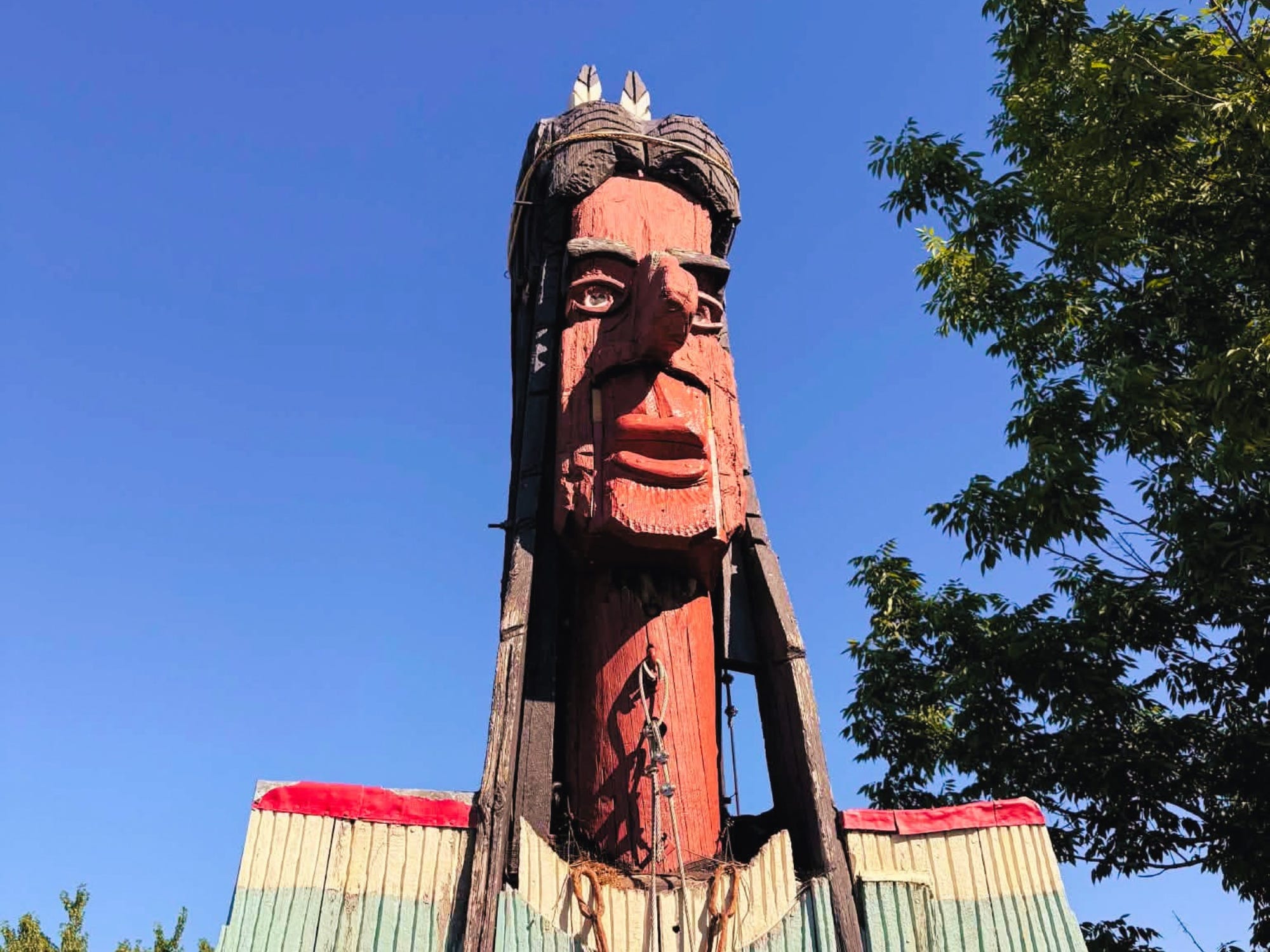
In 1966, Maine artist Bernard Langlais was commissioned by the Skowhegan Tourist Hospitality Association to craft a monumental sculpture that would serve the dual purpose of honoring the upcoming 150th anniversary of Maine statehood and attracting tourists to visit the Somerset County mill town.
Skowhegan has long played an outsize role in the artistic landscape of Maine as the home of the Skowhegan School of Painting and Sculpture, which since 1946 has trained and hosted countless artists, including the likes of Robert Indiana, Alex Katz, Berenice Abbott and Ashley Bryan. Langlais - a sculptor and mixed-media artist originally from Old Town and himself an alumnus of the Skowhegan School - was the perfect choice for such an undertaking, with his whimsical, earthy, eye-catching wooden sculptures of people, animals and other figures.
As early as the 1960s, Langlais was already well-known around Maine for his public art, some of which was already displayed at the homestead he and his wife, Helen, maintained along the coast in Cushing, today open to the public as the Langlais Art Preserve. The Langlais estate strengthened its ties to Skowhegan in 2013 when it donated 21 original Langlais sculptures to Main Street Skowhegan, a local arts and business development organization. Those sculptures, including athletes, mermaids and many different animals, are on display throughout the town, and are part of the Langlais Art Trail across the state.
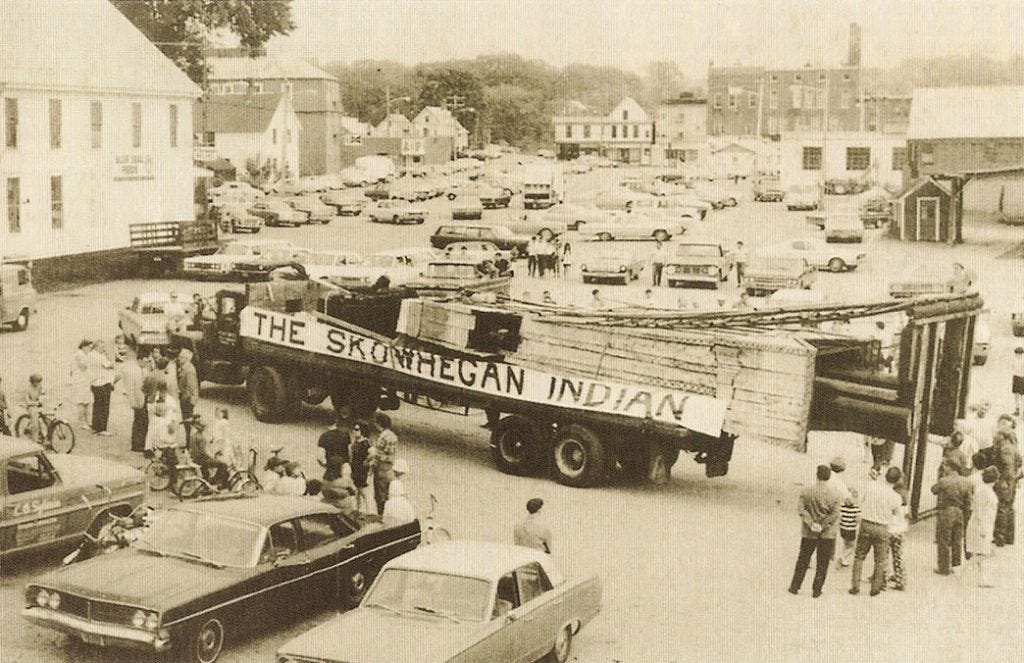
It took Langlais nearly three years to build the commissioned sculpture, constructed in Cushing before being trucked to Skowhegan and erected atop a huge steel-and-concrete base and frame. In 1969, the town unveiled what would become Langlais’ most well-known work: the Skowhegan Indian, a 68-foot-tall wooden depiction of an Abenaki man, dressed in deerskin and holding a fishing net and spear. The plaque for the statue said it was “dedicated to the Maine Indians, the first people to use these lands in peaceful ways.”
At the time, such a dedication seemed appropriate for Skowhegan, which for millennia was home to the Norridgewock tribe of Abenaki, who fished and farmed its waters and fields and had a thriving village on the banks of the Kennebec River until European settlers showed up in the 18th century. The town’s high school sports mascot was an Indian. Back then, hardly anyone in Skowhegan batted an eye.
The broader context
Commissioning and creating such a statue today would be unthinkable. There’s now a much broader mainstream awareness of the historic violence and oppression enacted upon Indigenous people in Maine and across the Americas by people of European descent. Having a white artist create such a work - especially one that depicts a Native person who lived hundreds of years ago - would today be considered offensive. The land that would become Skowhegan was a site of some of that violence in 1724, when white settlers murdered more than 80 Abenaki people and burned down their village in what is now known as the Norridgewock Massacre.
In 2019, the town voted to retire the Skowhegan Indians as its mascot - the last Maine school to remove its Indigenous mascot. The protracted, multi-year public debate leading up to the vote divided the community between those who believed the mascot should stay, and the Wabanaki people, Skowhegan residents and other people statewide who had been arguing for years that the use of an Indigenous person as a sports mascot is fundamentally racist and offensive. That same year, a new state law passed that banned Native American imagery as any part of public school branding or mascots. Though the matter is now settled, the memory of it remains.
Despite such a controversial legacy, in 2026, the Skowhegan Indian still stands - a bit worse for wear, as nearly six decades of wild Maine weather and industrious local squirrels have eaten away at the wood. The statue was initially restored by the Skowhegan Chamber of Commerce in 2014, but a planned maintenance schedule was not adhered to, and within a decade, the statue had once again fallen into disrepair.
In 2023, after massive wind storms and floods caused millions of dollars in damage across the state, parts of the statue’s face and hands had fallen off. Faced with another expensive slate of repairs, the chamber opted instead to sell the statue to any individual, business or nonprofit that would agree to take over the maintenance. The cost? $1.
Initially, no one stepped up. The chamber estimated the total cost to completely restore the statue could reach as high as $100,000, which would require some serious fundraising on its behalf. Add to that the complicated history between Wabanaki tribes and the town of Skowhegan on the topic of Indigenous representation in public settings, and it’s likely that getting involved in such a hot button issue would put off interested parties. The chamber said that if they couldn’t eventually find a buyer, they’d likely dismantle the statue.
The offer stood for nearly a year until local business owner Joe Almand decided to take a chance on the Skowhegan Indian. Almand, a former firefighter who now owns Joe’s Flatiron Cafe in Skowhegan, was part of the original restoration team in 2014. He initially approached the chamber about taking them up on the $1 sale in the fall of 2025, but it took nearly eight months - and the formation of a nonprofit - for the deal to go through in May of this year. Almand and a team of volunteers undertook a first round of restorations this summer, but it will likely take several years to fully restore the statue.


‘Something truly transformative’?
Almand understands the statue is controversial. But in his mind, it was more important to make sure it stayed standing than to let it disintegrate or be torn down.
“At the end of the day, I just felt like it would be a huge shame if it ended up falling apart or being torn down,” Almand said. “It’s been an icon of this area for so long, and it would just feel really bad to me if it went away. I know it’s a huge liability. I know I’m taking on a ton of risk. But the alternative just didn’t sit right with me.”
Almand said he would welcome collaboration between Wabanaki artists and organizations in the restoration process or as board members or advisors to the nonprofit, Watching Point, which was founded earlier this year. Currently, the board is composed entirely of Skowhegan locals, and Almand hasn’t yet actively sought to recruit any Indigenous input on the project.
John Bear Mitchell, a Penobscot Nation citizen, artist and media consultant who has served as an advisor on TV shows like “Welcome to Derry” and “The Devil You Know”, sees it a little differently. To him, without working directly with Wabanaki on the restoration progress, the statue will never be more than a stereotypical vision of Native folks through the eyes of white people.
“One of the main things I try to do in my work is focus on the complex, problematic remnants of white settler culture that seek to freeze Wabanaki people in the past, and ignore the fact that we are still here,” Mitchell said. “These types of monuments represent some sort of default standard that ignores our presence and locks us into a time in history when we were considered the ‘noble savage.’ It really just continues a pretty negative narrative, especially when there’s no context given.”
There are some in the Skowhegan community who still believe the mascot should have stayed, and that any related controversy around the statue is totally overblown. And there are many people, Wabanaki or not, who believe that there’s no scenario in which the statue as it looks today can remain standing and not be an offensive stereotype that represents a dark, violent past - and that it can, and must, be removed.
Almand believes it’s a piece of art, and that any public art is meant to inspire conversations - which is why he wants it to remain in the community.
“The thing that I always come back to is this is a piece of art. And art is supposed to make you think, and feel, and have conversations with people,” said Almand. “This [statue] definitely does that. I would rather have it keep doing that, than have it not.”
Bernard Langlais, who died in 1977, understood that by using his preferred medium of wood and then placing his sculptures outside in Maine that his work would necessarily be somewhat ephemeral. The Kohler Foundation, which with the Colby College Museum of Art and the Georges River Land Trust operates the Langlais Preserve in Cushing, has said that it doesn’t expect the sculptures to have “infinite life” - and that in fact it is its relative transience is part of its beauty and personality.
Rather than remove the statue altogether or wait for time and the elements to wear it away to nothing, Mitchell thinks a better option would be to do the work to reimagine it altogether, by pairing Wabanaki and Maine artists and community members in collaboration on something new, that could reflect a complex, difficult history and look toward a better tomorrow.
“The frame that statue sits on is good and solid. To me, that seems like a great base on which to build something that really takes into account the full history of the region, and that would take into consideration both the proud heritage of that city, and whose land they actually are on,” Mitchell said. “It’s already falling apart. Why not make the rebuilding something truly transformative? We could really do something profound.”