
Coconut, potato, grandmas and Maine
Or; Where did the Needham candy come from?
You’re on a long-ish drive to or from somewhere, and you’ve stopped at a country store in a tiny Maine town to pee and get a snack. Not a Circle K or a Cumberland Farms or a Freshies - a store called, like, RJ’s Variety, or Campbell’s Family Store, or Little River Market. Creaky floors. An ancient Slush Puppie plywood cutout on the front facade. You can get your deer tagged in November, or park your four-wheeler there in the summer.
You bring your snacks up to the counter and notice some dark brown little hockey puck-like candy things stacked next to the register, hand-wrapped in plastic. If you’re from Maine, you probably know what it is. If you’re not, you might ask the woman behind the counter about it, and she might reply that it’s a Needham - sweetened potato and coconut coated in chocolate. It’s a Maine thing, she says. Her friend’s mom makes them for the store. Weird, right?
It’s a rather peculiar thing, when you really think about it: why is a coconut-based confection the most iconic candy made in Maine? Why is the Needham a staple of grandma’s holiday candy-making operation and tourist-friendly candy stores statewide? And who first put coconut and potato together?
Whenever I try to answer a question like that in regards to food I usually start with the ingredients. For the Needham, it’s a pretty short list: potato, coconut, sugar and chocolate. This is when I get to Google things like “when did flaked shredded coconut become widely available” and put whatever answers I find to legitimate use. Here’s what I found out.
The coconut palm is native to Southern Asia, in the area where the Pacific Ocean meets the Indian. It’s believed Austronesian settlers brought the coconut with them on their sea voyages around both oceans, naturalizing the coconut throughout the Indo-Pacific. In fact, there’s a much-debated theory that suggests that many-thousand year old remains of Pacific coconuts found in Panama may indicate that Austronesian sailors visited Central America and introduced coconut to the Americas as early as 4250 BCE - long before the other theory, which is that the Spanish introduced the coconut via their colonies in what is now the Philippines. But, as I so often do, I digress.
Anyway, coconut remained a delicacy generally restricted to tropical areas until the 19th century, when colonial powers began to establish coconut plantations in Southern Asia, the Caribbean and parts of Africa, with the main goal of processing them into oil. While coconut oil was used for a variety of applications, the coconut meat didn’t begin to be widely used as a culinary product until the 1890s, when producers figured out how to dry it out to increase its shelf life. There’s a semi-famous story involving a Philadelphia flour miller who in 1895 received a shipment of coconut in payment of a debt from a vendor. He dried it, shredded it, sold it to stores and was shocked to find that customers loved it. That business, Franklin Baker, still sells coconut products today.
By the early 20th century, there was an explosion of coconut recipes across the U.S., Canada and the United Kingdom, like coconut cream pie, cakes, pudding, cookies and other treats. Interestingly, Scotland has a famous confection that also historically combines potato, coconut and chocolate into what they call a Scottish macaroon - though in that case, the mashed potato is sweetened, coated in chocolate and then rolled in coconut. Is the Maine Needham related to the Scottish macaroon in some way? Did a Scottish person emigrate to Maine and bring the potato-coconut knowledge with them? Or is it just an incredible coincidence?
In Maine, the story promulgated is that a Maine confectioner, John Seavey, invented a recipe that mixed dried coconut, mashed potato and sugar and then coated it in chocolate. Seavey named his new treat a Needham, after Boston-based George C. Needham, an Irish American Baptist preacher and writer who, according to his 1902 New York Times obituary, was a very colorful character, touring the world preaching the gospel and writing and selling a constant stream of evangelical tracts. Needham claimed that, as a child, he was forced aboard an English ship bound for South America, where he eventually was “nearly eaten” by cannibals in Patagonia. Between that and the Bible-thumping, he made quite the name for himself - so much so that he was something of a household name in late 1800s New England. Today, it would be like naming a candy after a Christian influencer. Yikes.
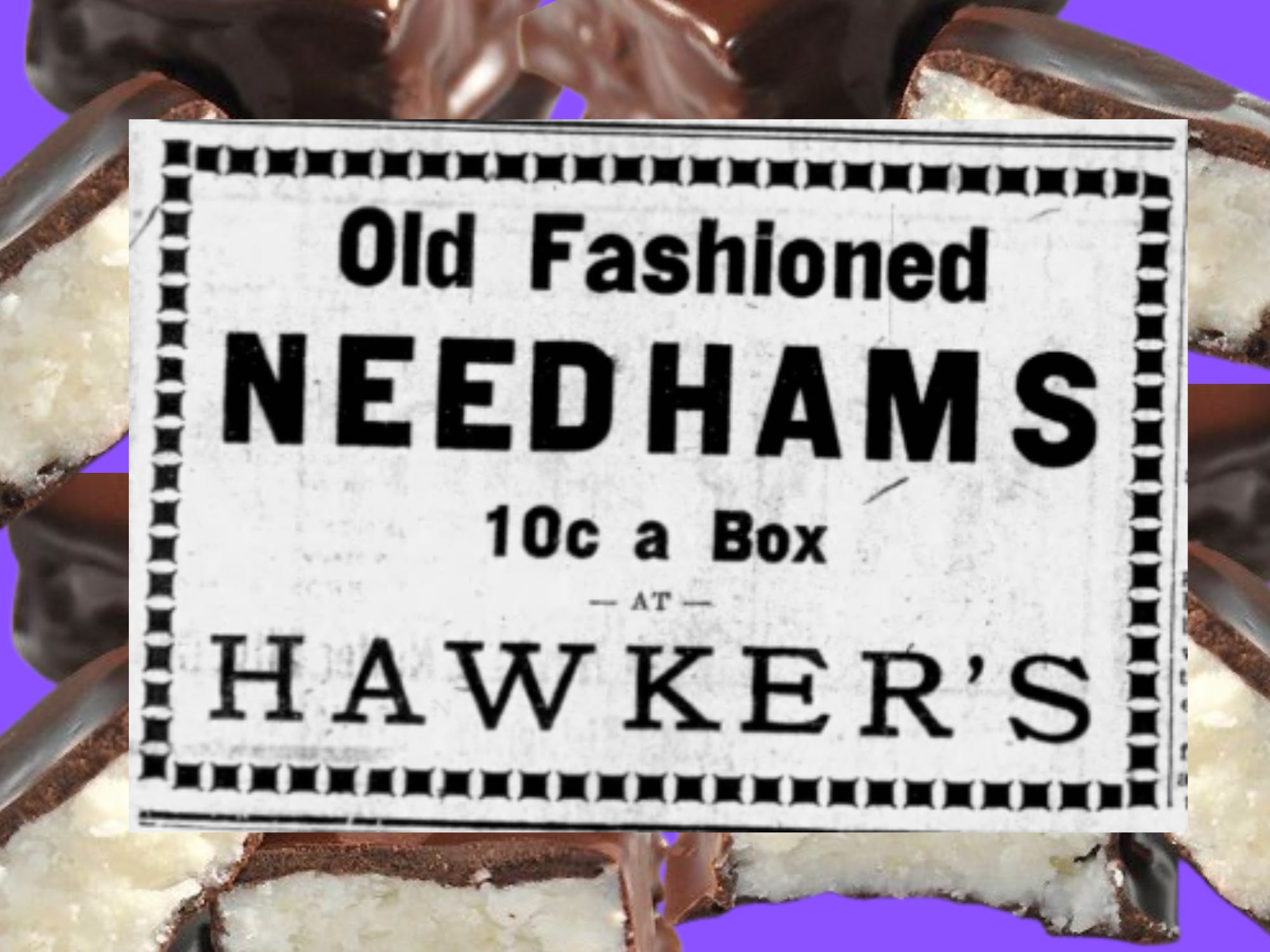
The earliest references I can find to Needhams in any Maine newspaper are from the Lewiston Sun-Journal in 1906, Waterville’s Morning Sentinel in 1908, and the Bangor Daily News in 1925. The Maine Needham Company, which has since 2007 sold Needhams in stores and online, claims on its website that Seavey invented the Needham in 1872, but given that shredded coconut wasn’t widely available in American markets until the 1890s, this seems unlikely.
This likely inaccurate date was repeated by a Bangor Daily News reporter in 2019 - wow, she did a bad job researching, didn’t she? She should be ashamed of herself. I hope wherever she is now she is atoning for this lazy oversight by publishing a 1,200 word essay on the Maine Needham. Someone should update Gov. Janet Mills, since she proclaimed Sept. 27, 2025 Maine Needham Day, and specifically cited the 1872 date in her proclamation. But I, as usual, digress.
It’s more likely that the Needham was first dreamt up sometime between 1890 and 1900 - perhaps by Seavey or another confectioner, or perhaps by an enterprising home cook. The other main ingredient is potato, after all, Maine’s largest agricultural crop and the iconic staple product of Aroostook County. The potato part is actually completely unsurprising - it’s the coconut that’s the oddity in the Needham. Old-fashioned Maine food is not particularly known for its bold flavors and experimentation and variety of ingredients. An old Maine relative of mine from the Boothbay area considered garlic “spicy.” Coconut probably seemed intimidatingly exotic to an old Mainer.
And yet, it’s easy to imagine grandma or mémère looking at a glob of leftover boiled potatoes, a bag of shredded coconut and some sugar and thinking it might taste all right together - especially if it was dipped in chocolate. I can also see a situation wherein someone might have wanted to actually make macaroons, but lacking eggs, decided to see if potatoes might work as a binding agent. And I can see yet another scenario in which the Needham was actually invented as a means to stretch pricey ingredients like sugar and chocolate by padding a recipe with cheap and plentiful potatoes.
At the end of the day, I suppose it doesn’t really matter who invented the Needham, or when they did it. It’s not like anybody knows who invented the whoopie pie, either. All we really know is that it’s as Maine as a lobster in Bean boots. Now, the real question is: would a lobster wear eight tiny Bean boots on each of its walking legs? Or would it wear two slightly larger but differently-sized boots on its claws? I, for the millionth time, digress.


